

The Price Of Bread In 1950 Will Make Your Head Spin

The fact that prices at grocery stores are getting noticeably higher, and at a faster rate than we might have been accustomed to in the past, comes as no surprise. The expected rates of increased food prices are bound to affect the average grocery budget in homes across the United States. Among the many staple food sources where consumers are noticing a spike in cost is bread thanks to multiple factors, including the cost of ingredients, labor, and import and export costs. To gain a better understanding of how inflation has impacted the price of bread, let's take a quick trip back in time to the 1950s, when the price of bread would make you do a double take if you came across such value today.
According to data from Illustrative Mathematics, which traced the cost of 1 pound of bread (or one standard loaf according to some laws) from 1930 to 2010, an average loaf of bread cost just 12 cents in 1950. In September 2025, according to the U.S. Bureau of Labor Statistics, an average loaf of bread cost a whopping $1.87 — a roughly 1,450% increase. However, the price of bread has actually come down a bit since its peak cost of $2.03 in January 2024. Here's to lower costs yet.
The cost of bread and the economy
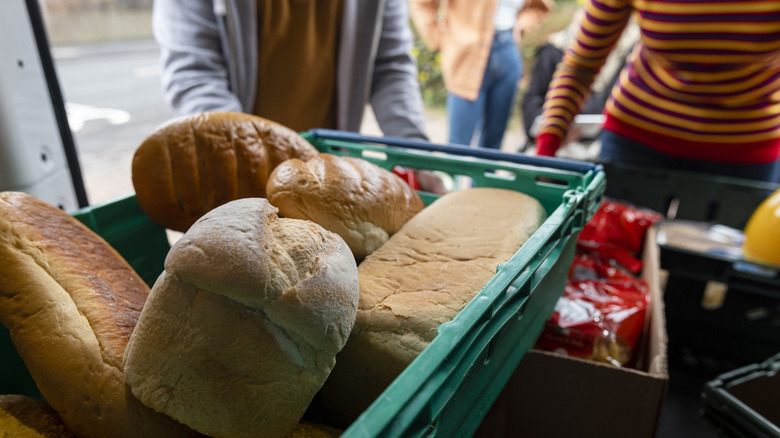
Of course, it doesn't do anyone any good to look at the cost of bread in a vacuum. For example, when the 1950 12-cents-per-loaf cost of bread is adjusted for inflation to September 2025, the numbers no longer look so grim. Those 12 cents today would equal $1.66, making the $1.87 cost per loaf just a roughly 13% increase. This certainly isn't nothing, especially when everything else is also more expensive, but it isn't quite as bad as the initial shock can make it seem.
However, there are two more data points worth highlighting to better understand why bread prices feel so high today: How quickly bread prices have risen, and how slowly wages have increased. For the former, from January 2010 to January 2020, bread prices hovered around the same $1.35 or so margin (according to the U.S. Bureau of Labor Statistics). The start of the COVID-19 pandemic triggered a rapid price spike; from January 2020 to January 2024, prices lept 68 cents, a roughly 50% increase.
Regarding wages, putting aside that the federal minimum wage hasn't risen from $7.25 since July 24, 2009, the numbers are still pretty poor. Looking at the U.S. Bureau of Labor Statistics's data on median weekly earnings of full-time salary workers, January 2020 to January 2024 saw just a roughly 19% increase ($951 to $1,135). The percentage increase from January 2010 to January 2020, when bread prices were essentially constant? About 27% ($748 to $951). Take us back.