

Aluminum Foil Can Go In Some Microwaves. Here's How To Tell If Yours Is Safe
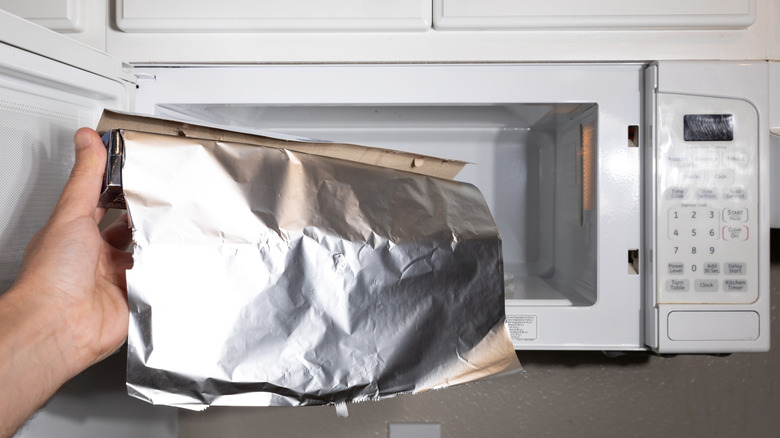
For many of us, it's just common sense that aluminum foil and microwaves are not a match made in heaven, unless you're hoping to potentially start a kitchen fire. But it turns out that there are a few situations in which you can pull it off without showering your microwave in sparks. The first step is to break out your microwave's manual and look through it to see what it says regarding aluminum foil. Some manufacturers, including big names such as Whirlpool and Maytag, acknowledge that foil can be used in certain microwave models to a limited degree. If it's not mentioned, it's safest to assume that you shouldn't put any foil in your microwave.
However, even if your microwave manual says foil is okay, it doesn't generally mean you can throw a dish wrapped up in several feet of aluminum foil in there. There are usually additional guidelines, and they're quite finicky. Firstly, the foil should be flat and smooth — no wrinkles or folded edges (it doesn't matter if your foil goes dull- or shiny-side-up, as the difference isn't relevant here). It can only cover part of the food (around 25% is the recommended limit). On top of that, you should keep any foil at least 1 inch from the microwave walls, ceiling, or base, and make sure it avoids contact with metal racks or turntables. Oh, and Pop-Tarts still aren't safe to microwave, as their wrappers are a mix of metal and plastic.
What else to know about foil in the microwave
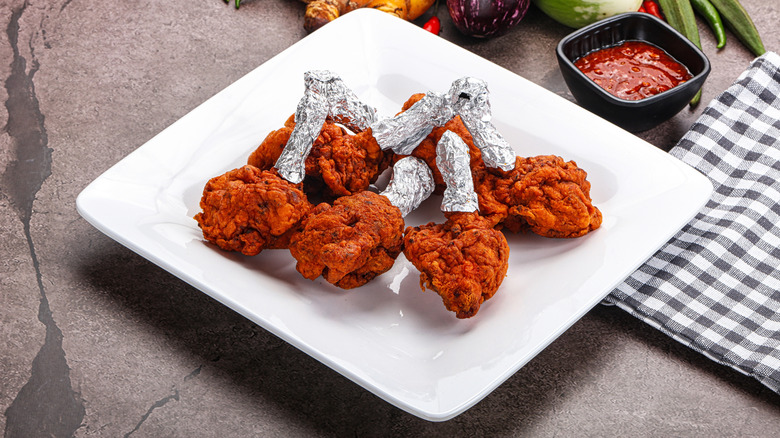
It's also recommended that you don't leave foil unattended in the microwave — stay in the room, just in case the sparks start to fly. With all these rules, it's perhaps hard to picture a clear situation in which you might want to bother with foil in the microwave. One suggestion is to use it to protect certain parts of a dish that you don't want to heat up, as foil reflects heat (so if a dish is totally covered, it won't heat up at all). Consequently, it's possible to use it to cover wings or leg tips on turkey or chicken. However, even this can be complicated, as you'll need to keep the foil as smooth as possible, which is difficult if you inevitably have to bend the foil to wrap a small section, such as a leg tip.
The reason that foil sometimes sparks in a microwave is because the electromagnetic waves that microwaves use get caught between pieces of metal, bouncing back and forth within those creases. This builds up charges that turn into sparks. In contrast, when the foil is super smooth, the waves just bounce back. Ultimately, tin foil is safe to use in the air fryer and oven, but it's probably not worth using in the microwave due to the amount of caution required. Yet if you find yourself in a situation where it's somehow necessary or unavoidable, it's theoretically possible — just check the manual.