

Don't Make Pine Needle Tea From Foraged Needles Until You Read This
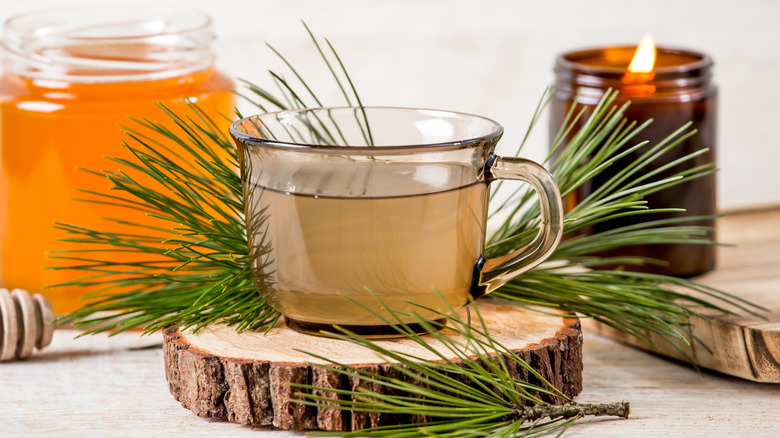
When looking for some new ingredients and recipes, you may want to consider foraging in the wild to expand your palate and your pocketbook. For example, acorns are a super versatile ingredient you can find growing wild across the country. You can contact a local mycological society to forage mushrooms that taste just like chicken. And you may be surprised to learn that even pine needles are edible. They make a delicious pine needle tea that's full of vitamin C and has a slightly bitter, woody, citrusy flavor.
However, as with foraging any wild plants, it's important to know what you're doing when choosing pine needles. For some guidance, we reached out to Alan Muskat, a foraging educator and the founder of No Taste Like Home in Asheville, North Carolina, a foraging education company that hosts classes and tours throughout the region. Muskat explained that misidentification can be seriously dangerous and even fatal if you're not careful. To stay safe, he emphasized one simple rule: "For an amateur, misidentification is not at all a concern if they do what every amateur should do, which is to never eat anything you haven't shown to an expert."
The dangers of foraging for pine needle tea without an expert
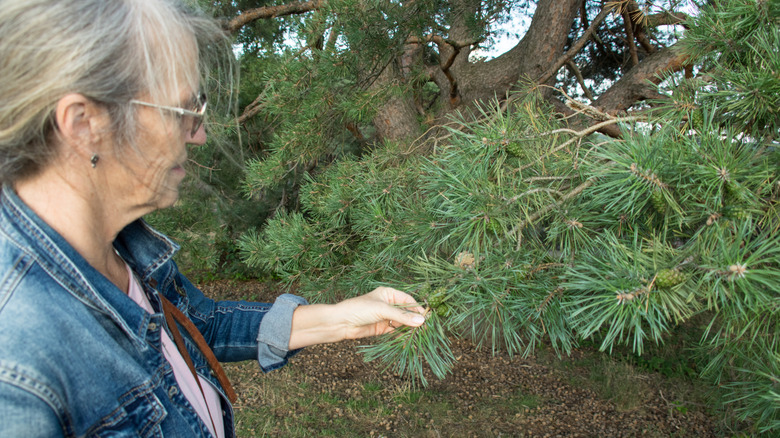
"The danger is not in misidentifying pine needles, it's in misidentifying who is an expert," Alan Muskat said. In other words, you shouldn't consider yourself an expert until you've truly earned that status. He shared a story about one of his trainees who incorrectly identified a poisonous yew tree as an edible pine. "A trainee should not think they are an expert. Not only should they not be eating anything without showing it to one, they should certainly not be teaching," he said, explaining that consuming the needles of a yew tree can be deadly. "To someone unfamiliar with them, any two plants can look alike," he added.
For those new to foraging, Muskat advises never doing it alone. "What is deadly is not nature, it's our hyper-individualistic culture that continually thinks this way. DIY is DUM. What's smart is DIT: doing it together," he said. If you're not an expert, you can always buy needles for your pine needle tea from a reputable seller. But "if you want to learn natural food, do it the natural way: learn from an expert," Muskat advised. He said you can usually find one who will show you for free and added that no one is turned away from his classes for lack of funds. "There was a time when every human on earth was a forager," he said. "Being a forager doesn't mean gathering your own food. It means sharing everything with your community, both food and knowledge."