

The Wine Temperature Rule That Could Make Cheap Pours Taste Better
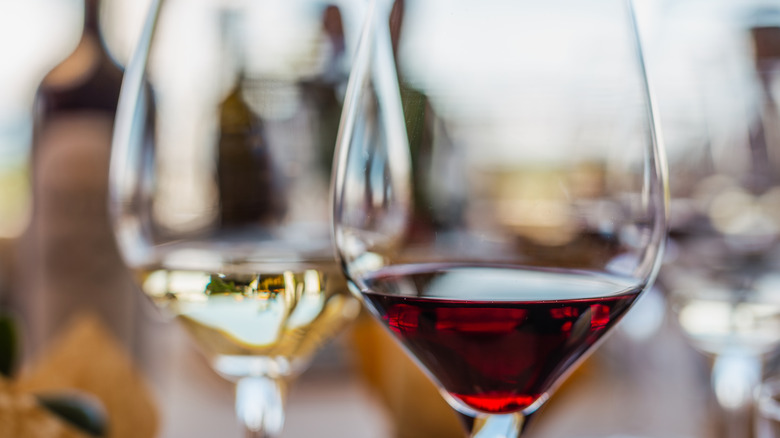
Believe it or not, how you store and serve wine can affect its taste, and temperature can make or break your experience of drinking it. A delicious wine can have its complexity and flavor muted by being served too warm or too cold. Conversely, wines on the lower end of the cost and quality spectrum can be significantly improved by being served at the correct temperature. To find the perfect balance, we spoke to Peter Kecman, sommelier at the World Equestrian Center.
We specifically asked him about the 30-in or 30-out rule (aka the 30-minute rule). It's an easy (if slightly imperfect) method to elevate your wine-drinking experience, especially for those on the lower end of the price spectrum, where serving at an exact temperature is less of a requirement. Essentially, the rule argues that room temperature red wine should be placed in the fridge for 30 minutes before drinking — and that chilled white wine should be left out of the fridge for 30 minutes before you crack it open. The rule's simplicity makes it ideal for casual wine drinkers. "If you cannot store wine at a perfect temperature, it will certainly be a quick, efficient, and inexpensive solution," said Kecman.
Inexpensive red wine needs 30 minutes to chill
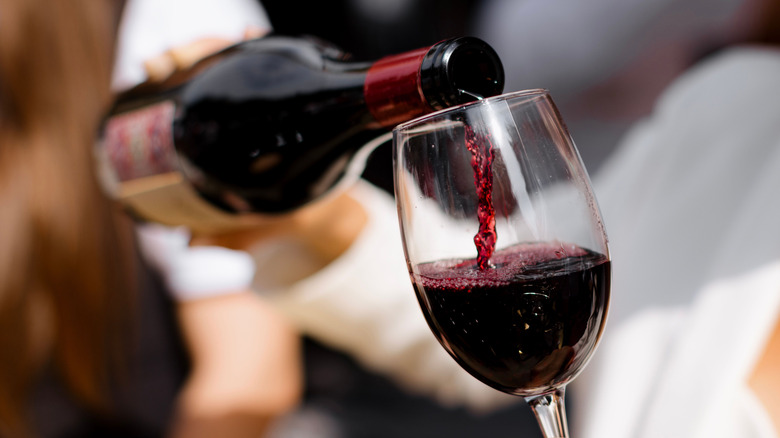
Of course, the 30-minute rule isn't one-size-fits-all (though it is about as close as you can get). Certain wines will likely benefit more from some time in the fridge than others. Take, for example, a red wine on the lower end of the spectrum in both price and quality. According to Peter Kecman, slightly chilling red wines can result in drastic improvements to both their balance and drinkability. "30-in, 30-out will improve the performance of inexpensive red wines," he said. "Slightly chilled, lighter-bodied red wine with higher acidity, like old-world examples of pinot noir, tempranillo, or sangiovese, will benefit more than fuller-bodied, high-alcohol cabernet from Napa."
Of course, there are examples of extremely full-bodied old-world wines, too. Something like a super Tuscan — a heavy red wine made in that eponymous region in Italy using non-native grapes like cabernet, syrah, or merlot — will benefit slightly less, as will nebbiolo, Barolo, and the like. However, for the majority of lower-end red wines, a 30-minute sojourn in the fridge will greatly improve their drinkability. A large temperature mistake with red wine is serving it too warm. Light-bodied red wines should be served at the same temperature as full-bodied whites — around 50 degrees Fahrenheit. Medium- and full-bodied reds can be served at temperatures up to the low 60s.
Inexpensive white wine needs 30 minutes to rest

The 30-minute rule is a great quick fix for the cheapest grocery store wines, but it's not as reliable with white wines as it is with red. "Inexpensive white will not benefit as much as red wine," Peter Kecman told us. "Fuller-bodied, more complex chardonnay from Burgundy will perform better at the temperature close to cellar-room temperature. Inexpensive pinot grigio not so much." While full-bodied white wines can be enjoyed at the warmer end of the spectrum, Champagne, sparkling, and light-bodied white wines are best served between 42 and 50 degrees Fahrenheit.
It's important not to rush anything when it comes to wine — something that takes so long to make deserves better than a rushed preparation process. "There is no way to quickly adjust the temperature of warm red or cold white wine," Kecman explained. If you're in a pinch, though, there are ways to speed things up a little. "One can always decant red wine and help it open up much quicker," he said. This is better done after allowing it to reach the right temperature.
So, use the 30-in or 30-out rule to soften harsh reds and open up white wines, but don't expect miraculous results. The goal for these cheaper wines should be to balance them, not to transform them entirely. Remember that the 30-minute rule is more of a hack than a habit — knowing the exact temperature to store and serve your wine will always be a better option.