

The Mistake That Could Be Giving Your Pie A Soggy Bottom
We may receive a commission on purchases made from links.
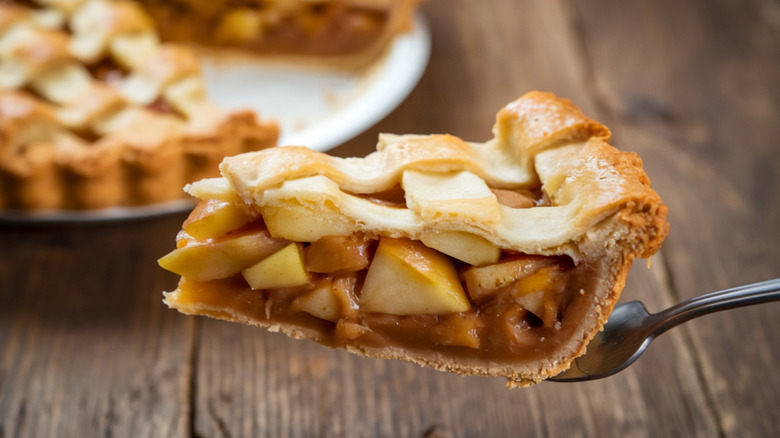
You've just baked a flawless pie with a golden-brown lattice and a tender, aromatic filling. But as soon as you cut into it, you're met with what every baker dreads: a soggy bottom. So how do you avoid such a tortured fate? For starters, choose your pie vessel wisely.
To find out how to make the perfect pie dough, we spoke with Erin Jeanne McDowell, baker and author of "The Book on Pie," and John Kanell, baker, cookbook author, and founder of Preppy Kitchen. Both of our experts emphasized that the material of your pan can dramatically affect the outcome of your pie. "Metal will just conduct the heat better than the glass or ceramic and you'll see in general it's a browner crust," Kanell said. McDowell echoed this sentiment. "[Metal] does the best job of browning and is the most nonstick," she said, though keep in mind that food may still stick to your nonstick pan if it's overheating.
If you don't have a metal pan on hand, McDowell said ceramic is your next best bet. "Look for pans with a glossy finish, as more matte surfaces tend to be prone to sticking," she explained. She recommended steering clear of glass pie pans entirely because they brown the bottom crust poorly. If that's all you have on hand, consider saving the pie for another day and whipping up a batch of cookies instead.
More mistakes that might be sabotaging your pie crust
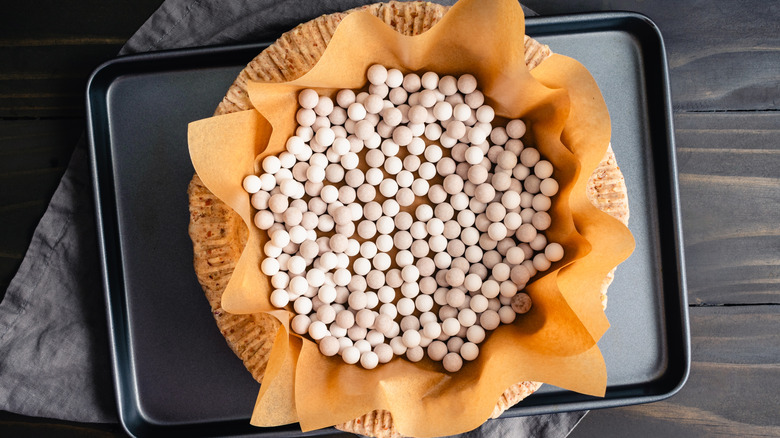
While pan selection may be one of the most important steps in avoiding a soggy pie base, there are other precautions you can take as well. Knowing how to properly cook your crust is just as important. Depending on what kind of pie you're crafting, you'll want to either par-bake or blind bake your pie (and yes, you can blind bake your crust without pie weights).
Though often used interchangeably, the two terms mean different things. "Par-baking stands for partially baking a crust," Erin Jeanne McDowell explained. The process allows the crust to firm up a bit before fillings are introduced. "This applies to any single-crust pie that has a filling that requires baking (including fruit fillings or baked custard fillings like pumpkin or pecan pie)," she added. Blind baking, on the other hand, means cooking a crust all the way through before adding the filling, and it should be reserved for pies with fillings that require no bake time (think coconut cream or lemon meringue).
Crust preparation isn't always the cause behind a soggy bottom. "Of course you might have a soggy filling," John Kanell pointed out. Adding to that, McDowell explained that "not pre-cooking fruit fillings and using raw fruit for an overly juicy filling" often causes excess liquid, which soaks into the crust and makes it soggy.