

How To Craft A Perfect Korean BBQ Ssam
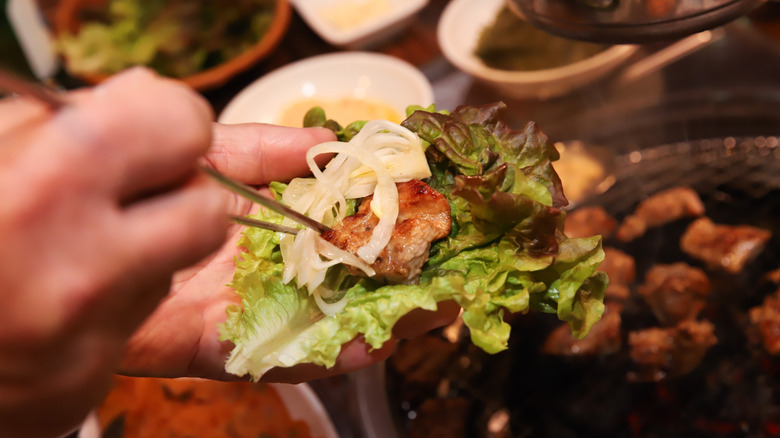
If you've ever been to a Korean BBQ restaurant, you've likely encountered ssam, which is a delicious one-bite serving of meat and rice wrapped in a lettuce leaf and topped with a rich condiment. You might have questions about how to wrap the best ssam, which sauces complement it, and lastly, the proper way to eat it. To find the answers, we reached out to Sam Yoo, chef and owner of Golden Hof, who spoke exclusively with Chowhound to offer advice on preparing and eating ssam.
There are a few tips for making a Korean barbecue an unforgettable meal, and your culinary exploration will likely include making ssam. According to Yoo, there's a traditional way to enjoy it, with one caveat: "The only right way is that you're choosing your own adventure." He explained further: "The classic way is, you pick your lettuce or your perilla leaf and then you get some rice on there. Then you get your piece of meat, and then you put ssamjang, which is the soybean sauce." In addition to this foundation, Yoo suggested putting a banchan — a small, Korean side dish — in there, like kimchi, though some people choose to use raw garlic instead.
One important aspect about making ssam is to wrap it so you're able to consume it in one bite. Otherwise, according to Yoo, "It's really all about just what you want for that perfect bite that you want to eat, that you're craving."
Additional tips for making crave-worthy ssam
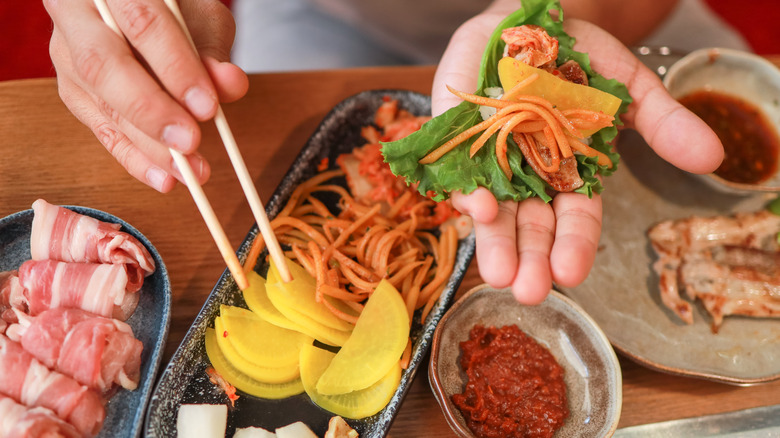
While there are numerous styles of barbecue sauce across the U.S., the ssamjang sauce you'll find at Korean BBQ restaurants is an important component of your ssam. In addition to what you'll find at a restaurant, you can create dipping sauces for homemade Korean barbecue, including ssamjang. Traditionally made of soybean paste, it can also contain garlic, sesame oil, soy sauce, and other ingredients.
Once you have all of your fillings and sauce, wrap the ssam. "I'll typically do lettuce, a bit of meat, and the ssamjang or kimchi," Sam Yoo said, explaining that you can add another type of banchan to further boost the flavor. What's key is to add the right amount of ingredients, though, so the wrap is edible in one bite.
Using lettuce with the proper texture is also key to making ssam that properly wraps your ingredients, ensuring they stay together. "I would say red leaf or green leaf lettuce is typically what you want to go for," Yoo advised, explaining that "romaine is a little too hard. Butter is a little too soft." Though choosing your own adventure is a fun way to enjoy ssam, Yoo suggested some fillings might not work. "I probably wouldn't put the myeolchi in there, which is the little soy candied anchovies," he said, explaining that the taste "would feel a little sharp." Yoo also told us that odeng, which are Korean fish cakes, might not be the best option either.