

The US State That Grows The Most Sweet Potatoes

There are many reasons to love the Tar Heel state. While there are many cities and towns within North Carolina that are worth a visit, you needn't step foot in its borders to get a taste of what it has to offer (and we're not talking about the presidential favorite soda, Cheerwine). Simply by cooking up some sweet potatoes, you might just be tasting the fruits (well, technically vegetables) of North Carolina. While not all sweet potatoes come from North Carolina, the state has led the nation in sweet potato production by a good margin for over 50 years.
Though sweet potatoes have been a North Carolina staple for hundreds of years, production of the tuber really kicked off after the state's tobacco industry began to wane in the mid-20th century. By 1971, North Carolina officially became the No. 1 grower of sweet potatoes in the country, a title it has carried every year since. In 1995, the sweet potato was named the state's official vegetable, beating out the other potential candidates, corn and collard greens. The state's investment in the sweet, versatile veggie has more than paid off since the 21st century has seen a sharp increase in the sweet potato's popularity.
The rise of the sweet potato in North Carolina
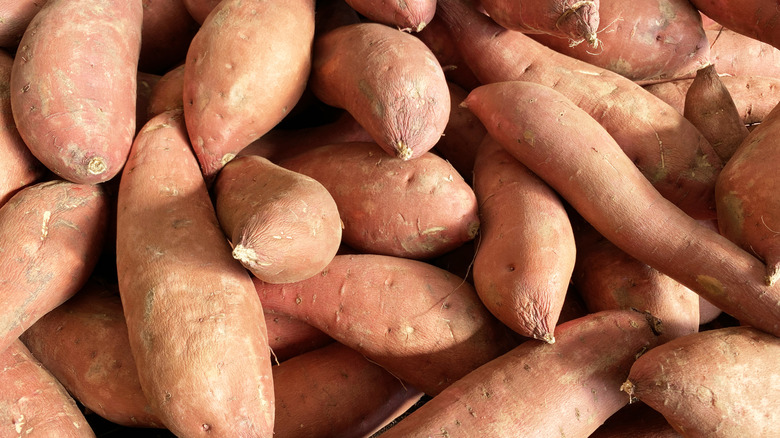
How did this tuber come to be one of this state's most lucrative and iconic agricultural products? Let's dig in. Sweet potatoes are originally native to Central and South America, but were brought to North America through colonization. The crop was grown in many places in America over time — George Washington even cultivated the crop at his Virginia home.
During the 18th and 19th centuries, when North Carolina was developing its agricultural identity, farmers in the state tended to focus on tobacco, a highly profitable cash crop. That doesn't mean sweet potatoes were nonexistent; in fact, the nutrient-rich tuber was uniquely suited to the state's climate and sandy soil, which tended to impair other crops from prospering. However, sweet potatoes weren't often farmed for profit, but for sustenance.
Sweet potatoes did have a bit of a renaissance during World War II, when the United States Department of Agriculture utilized the vegetable to help stretch short supplies of wheat and flour. Many Americans also planted these rich tubers in their Victory Gardens to help supplement food supplies. But really, the key to the sweet potato's success as a cash crop in North Carolina comes thanks to the decline of tobacco and the uptick in demand for the tuber. This, plus the development of heartier, pest-averse potato varieties, such as the Covington sweet potato (which makes up 90% of North Carolina's sweet potato crop), have made the sweet tuber a North Carolina staple.
A vegetable at the core of the South

Of course, sweet potatoes are not just a cash crop for many North Carolinians, but also a tie to the state's rich and complex history. During the period of colonization and the early days of the United States, sweet potatoes weren't so much a cash crop for farmers but a key part of smaller sustenance farms, which were developed to feed families and small communities. Sweet potatoes were also vital to those who were enslaved. Many enslaved people across the South kept sweet potatoes in cellars to store through long, cropless winter seasons. These nutrient-rich tubers kept many enslaved communities fed during a time when malnutrition wasn't just the norm, but a default. The sweet potato's association with economic struggle continued into the 20th century, when the tuber was one of the few reliable foods available to impoverished communities.
Sweet potatoes have long since become a staple of Southern cuisine, and are also a part of the rich landscape of soul food. Dishes such as sweet potato pie and candied yams are core dishes at Southern Thanksgiving tables and have a rich history, especially within Black communities in the South. And yes, we know that yams and sweet potatoes are actually two different vegetables. Yams, which originate from Africa, were brought to the Americas to cultivate, but failed to prosper — so sweet potatoes were grown in their stead. Enslaved people brought from Africa to the colonies saw sweet potatoes as the next best thing to yams, and so often called them yams. Centuries on, the two names are used interchangeably.