

How To Know When Your Bread Is Done Proofing And Is Ready To Bake
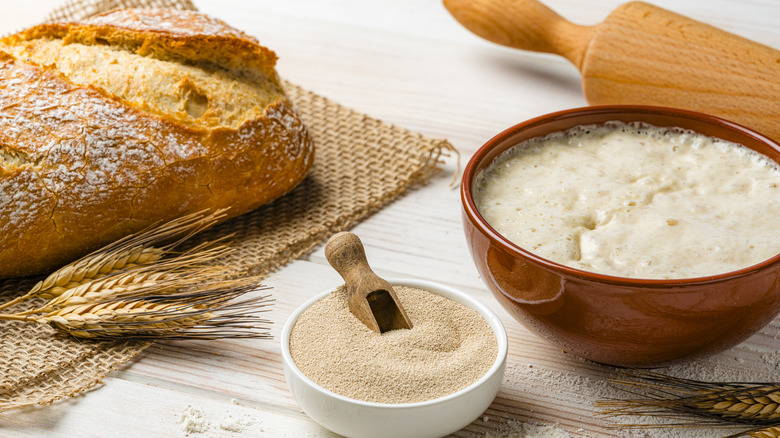
When it comes to baking bread, one two-phased step is both notoriously difficult and extremely important to get right: proofing. Proofing involves letting the bread dough rise before baking it, which requires leaving it in a warm environment for usually at least an hour. The terminology can get confusing because "proofing" is sometimes used interchangeably with "fermenting." It helps to think of it like this: Fermenting — also called "bulk fermentation" and "bulk proof" — is the first phase, where unshaped dough is left to rise under warm temperatures, and proofing — also known as "final proof" — is the second, where dough gets shaped into a loaf and left to rise again.
Because proofing is a two-step process with no exact timetable to follow (a recipe might give you a broad window), we have to rely on careful observation to know when it's done. Some say it's when the dough has doubled in size, but that can be hard to judge. That's why Chowhound turned to two expert bakers for exclusive insight. Charles Negaro, Jr., CEO of Chabaso Bakery and Atticus New Haven and co-founder of Connecticut Food Launchpad, says, "'Doubled in size' is a classic phrase, but visual cues can be misleading, especially with high-hydration or whole-grain doughs." Instead, he says his bakery Chabaso relies on "a combination of touch and timing."
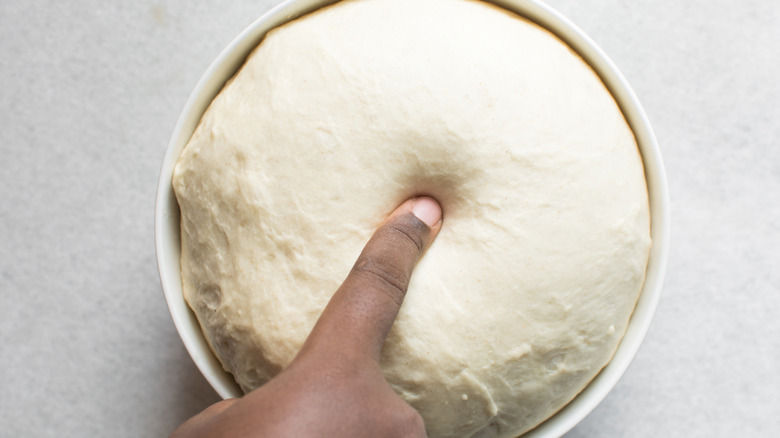
Erik Fabian, co-founder of Sourhouse, doubled down on this duo as the key to gauging a proper proof. "The texture of dough will become noticeably different — from dense and pasty to pillowy and bubbly inside," he says. Both recommend the "poke test" during final proofing. "A gentle press with your finger should leave a slight indentation that slowly springs back," Negaro says.
Signs of readiness in both phases
Since you need to proof dough twice — once in "bulk" and once shaped — there are slightly different signs of doneness to look out for in each step. According to Charles Negaro, Jr., "During bulk fermentation, we're mostly watching for dough relaxation, moderate expansion, and visible signs of fermentation such as bubbles or a smoother texture. This is when most gas production and flavor development happen." Erik Fabian adds that the visual cues are easier to spot in this stage. "With bulk proof, you can grab the dough, pinch the dough, shake the bowl and see how it jiggles, or see the bubbles from the side of the glass bowl," he says.
However, looking for these signs isn't always so simple. "With a shaped loaf in a banneton or loaf pan, you can't do any of that," Fabian notes. Instead, he says to examine how well the dough puffs up, holds its shape and fills the proofing basket, and when in doubt, use the poke test. "If it bounces back quickly, it's not ready. If the dent fills back up slowly, it's just right. If it stays indented, it's over-proofed," he explains.
Also, keep in mind that different kinds of bread dough ferment and proof at different paces. "Sourdough — which relies on wild yeast and bacteria — often needs a longer, gentler rise for full flavor and can handle a bit more fermentation without collapsing," Negaro says. "Whole-wheat doughs, because of their bran content, ferment faster and can become slack if over-proofed, while white bread doughs are more forgiving and easier to judge visually."
Why it's important to proof bread dough correctly
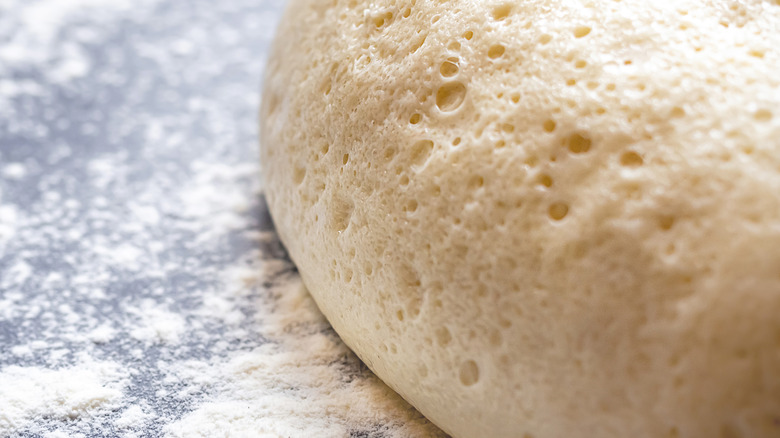
Proofing tends to frustrate novice bakers because it's passive in nature but can make or break the quality of your bread. "Getting the rise just right during both bulk fermentation and final proofing is key for flavor, texture, and structure in artisan bread," says Charles Negaro, Jr. This is when some of the most key biological processes occur — gluten forms and yeast and bacteria consume sugars, producing the carbon dioxide that causes the dough to expand. "This biological activity not only raises the dough but also develops delicate flavors and aromas," Negaro says.
It might seem like no big deal to cut your dough's rise time short, but that would be a big mistake. "When under-proofed, bread will have dense crumb instead of the airy, spongy structure, because there's not enough carbon dioxide generated from fermentation activity," explains Erik Fabian. "Baking under-proofed dough typically results in dense bread with poor oven spring and an overly tight crumb," Negaro adds, which doesn't sound appetizing at all.
Overproofing can also lead to unfortunate results. "Over-proofed dough tends to collapse either before or during baking, leading to flatter, sometimes gummy loaves with big, irregular holes," says Negaro. That's because the gluten structure has weakened and carbon dioxide has escaped. It is possible to fix overproofed dough in some cases, but you have to act quick. "If you let the proof go extremely long, the dough will lose so much gluten it will turn porridge-like," says Fabian.