

Martha Stewart's 'Subway' Kitchen Design Creates Optimal Functionality

Martha Stewart knows a thing or two about kitchen layout, and it doesn't just come from having cooked her favorite classic recipes in so many; she's also designed a fair few. From her original farmstead kitchen in Turkey Hill in Connecticut to the sleek metal-clad "Galley Alley" in her Fifth Avenue apartment and her iconic Bedford, New York kitchen, the cookbook icon has curated cooking spaces of all sorts. However, certain principles of kitchen design stay consistent across each of these kitchens.
One of Martha Stewart's foremost mantras for kitchen layouts is functionality. While the kitchen's aesthetic appeal is important, it mustn't come at the cost of efficiency. In an interview with Frederic Magazine, she explained how her cooking space channels the all-important criteria for functionality through its layout, saying, "All my kitchens have the same basic design — I call it the subway kitchen or the railroad kitchen. The workspace is divided with an island, there is a wall of stoves, a washup area, and then a seating area, and maybe an additional, more comfortable seating area."
For Stewart, the idea of functionality isn't just in how important kitchen elements like the fridge, stove, and sink are positioned (aka the kitchen triangle). The idea seeps into the shelving, which is kept open and shallow for easy access, and the furniture, which avoids upholstery and is, therefore, easy to wipe down. While her ideal kitchen is one with lots of space, open areas, and windows, her layout strategy can be adapted to kitchens of various sizes to improve functionality and add that touch of social cooking, which makes Martha Stewart's kitchens so inviting.
Creating zones around the kitchen island for maximum functionality
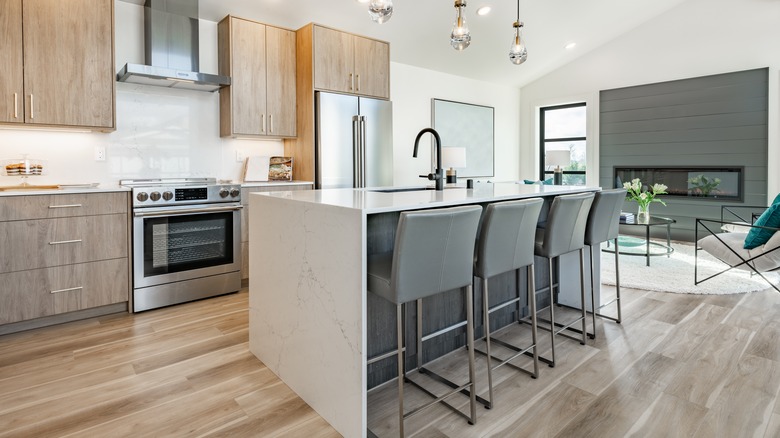
The key to Martha Stewart's "subway" kitchen layout is using the kitchen island to section the space. On one side of the island is the area for "serious" cooking with the stove, oven, fridge, sink, and prep areas. On the other side is a more relaxed social space that makes the kitchen feel inviting. Open shelving and overhead hooks for storing pots and pans abound all around the island, further ensuring ample space and easy access.
Depending on the available space, the kitchen area can wrap around one, two, or three sides of the kitchen island. The one-wall kitchen is for narrow spaces with the cooking area on the wall opposite the kitchen island. Both galley and bi-level style kitchen islands complement one-wall kitchens, with the latter offering more division of space between cooking and seating areas.
The L-shaped layout puts shelving and workspaces on two sides of the island and makes for the best kitchen triangle. Plus, it adds another of Stewart's functional kitchen elements, multiple workspaces: different sections of the kitchen island and along-the-wall counters for designated tasks. For example, Stewart likes zinc countertops for rolling dough. She also has a marble-top table for the same purpose in her Bedford kitchen.
If you have the space, the idea of multiple workspaces can be expanded to multiple cooking areas. Stewart has a stove on her kitchen island for crêpes and omelets, and one against the back wall for heavier tasks that require, say, a stockpot. For compact spaces, consider getting a chef's table, which is a trendy kitchen island alternative that's easier and cheaper to install but offers many of the same functionality benefits.