

This Cocoa Powder Alternative Will Take Your Hot Chocolate To New Heights
There are a lot of pleasure beverages — which is to say potable frivolities like wine, versus necessities like water — that exist on tremendously gradient continuums. Those simple fermented grapes, for example, can be had for as little as a few bucks, as well as for some truly unspeakable sums. Hot chocolate lies on a similar spectrum. For every hot chocolate mix to skip, there's an excellent convenience pick that'll create top-notch cocoa in a snap. And that's before you even think about all of the luxury options in circulation. There are just a lot of ways to drink your sweets, and eschewing the powder altogether is a terrific upgrade kickstart.
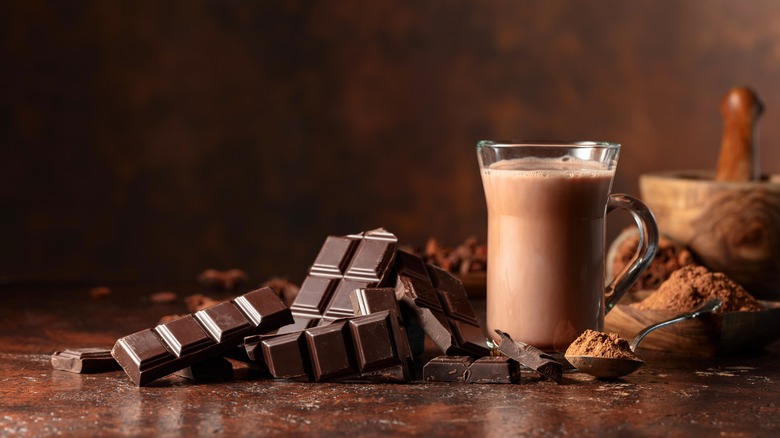
To split the DIY difference, Chowhound warmed up to Sasha Zabar, founder of hot chocolate hotspot Glace, to spill the beans. Glace, of course, always begins with top quality product, Zabar says. He wants the chocolate to join with the milk, neither ingredient obscured nor ignored. "We use couverture chocolate because it has a higher cocoa butter content, which melts smoothly and gives a glossy, velvety texture," Zabar says. When you see it, it'll often be fashioned into shiny little disks, but it might not populate the shelves at the corner shop. "If you can't find couverture, go for bars over chips," Zabar says. "Chips are designed to hold their shape in cookies, which means they're lower in cocoa butter and don't melt as evenly."
Making couverture hot chocolate at home

Chocolate secured, you still have to liquify the stuff. And Sasha Zabar says it helps to channel your inner pastry pro. "Treat it like you're making a ganache," he says. That means you should skip the old mug and microwave in this case and fire up the stovetop. Get your dairy steaming before you pour it over the chocolate in a separate container. You can even designate a gently warmed double boiler as that second vessel to keep the temperature somewhat consistent. You'll then want to whisk it all together to combine until it's just a bit too thick to sip before finishing with the remaining milk, continuing to whisk to silken completion.
You can adjust your proportions again and again in a delicious drive for perfection, but about 1 cup of milk to around 3 ounces of chocolate is a good place to begin. Zabar even suggests using a milk and cream blend which is decidedly more decadent than old whole alone. He even suggests tinkering with chocolate varieties like a two-to-one dark/milk ratio for extra depth, and adding a pinch of salt to really bring the flavors into focus. Although they certainly have their place, you might also want to skip the plastic bagged toppings in this case. You can make your own marshmallows with as few as three ingredients.