

The 'Holy Grail' Kitchen Find You Should Never Pass Up While Thrifting
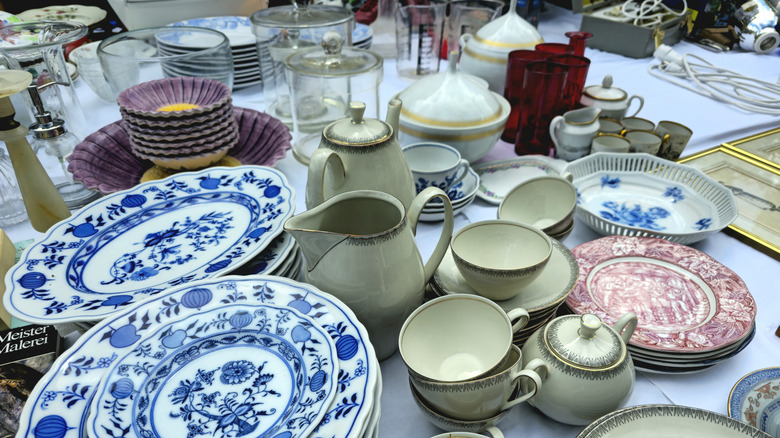
Imagine heading to a flea market, spotting a vintage kitchen item worth well over $100, and then checking the price tag to find that you can buy it for just $35. That's the kind of story that makes hunting for collectibles while thrifting so exciting, and why you should always keep an eye out for a particular type of dishware. If you come across an opaque mint-green glass baking pan during one of your thrift runs, you probably won't want to pass it up.
What you may have stumbled across is a vintage dish made of jadeite, a green glass that grew popular from the 1940s to the 1970s. These days, jadeite kitchen products can be a major dishware thrifting score (similar to coming across Libbey glass) given the popularity of their signature colors and the relative rarity of some of their pieces. The oldest pieces are fairly close to graduating from vintage status to being true antique glassware, driving up their value among collectors even higher. Even official reproductions that are only a couple decades old are often worth snagging, while the value of the originals would certainly be worth more than $100.
The material itself has made quite the comeback, so it's not too hard to find dishes made from it these days; even Walmart has jadeite on its shelves every now and then. Vintage pieces, however, are definitely worth scouring thrift shops for in large part due to their nostalgic designs, which would look perfect in a display cabinet or a repurposed kitchen hutch. Getting such a valuable piece for less than a third of its going price while thrifting is just icing on the cake.
Why jadeite kitchenware is so collectible
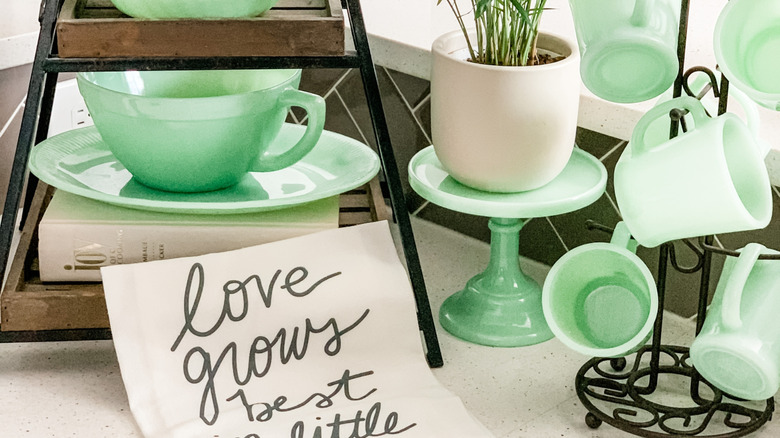
We can thank Martha Stewart for the jadeite craze. The TV personality and her daughter, Alexis, started their collections in the 1990s, and some of those pieces found their way onto Stewart's show. Viewers spotted the eye-catching dishware in her studio kitchen — elevated, of course, with the help of her fantastic kitchen design tips — and many decided to start collecting them, too. From there, jadeite's popularity saw such a resurgence that glassware manufacturer Anchor Hocking revived its Fire-King jadeite line in 2000; these reproductions are now vintage themselves and have also become sought-after items in the collector's market.
One of the biggest reasons collecting jadeite dishes is such an appealing hobby, however, is the fact that it's relatively accessible. While a single rare Fire-King mug can go for nearly $1,000 on eBay, you can still start your collection with some of the more common pieces, which can sell for as low as $5. These were, after all, mass-produced kitchen items, so there's a lot of supply out there. And again, there's always the thrill of finding undervalued dishware at a thrift store, since there are a lot of folks out there who just want to declutter all their grandparents' old things.
How to tell if vintage jadeite dishes are authentic
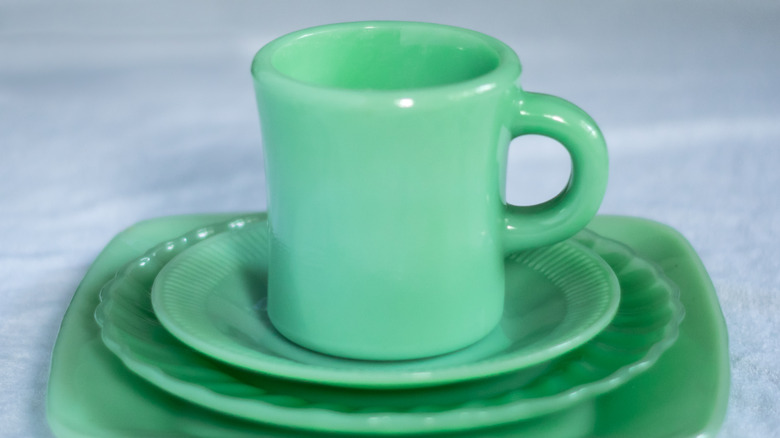
As with any collector's market, there are always going to be jadeite items out there that aren't what they claim to be. Some "vintage" items turn out to be recently made reproductions, while other pieces are what collectors label as "fantasy," meaning their designs were never actually part of the manufacturer's original lineup of products. If you spot one of these so-called holy grails while thrifting, you should check for certain markers of authenticity.
The easiest one to spot would be the stamps on the bottom of the dish. The three most collectible brands — McKee, Jeannette, and Fire-King — all have their branding embedded on the dishes themselves. For McKee, look for an "McK" stamp with the "c" floating in between the tops of the other two letters. Authentic Jeannette pieces will have a "J" inside a triangle, while Fire-King ones will have the words "Fire-King OVEN GLASS." Fire-King's reproduction line from 2000 will also include "2000" on the stamp.
If you have a black light, you can also shine it on McKee and Jeannette pieces; these will glow because uranium was added to the glass to achieve its color. These pieces are safe to keep in the house, but think twice about using them for food and drinks. Fire-King dishware won't have the same effect because Anchor-Hocking never added the element to its glass. True vintage pieces will have signs of wear and tear, and also lack the color uniformity that modern manufacturing methods produce. Lastly, online resources and the collectors' community document which designs are authentic, so if you've come across a jadeite dish, it doesn't hurt to check in with them.