

Why Pancakes Taste Better At Diners Than At Home
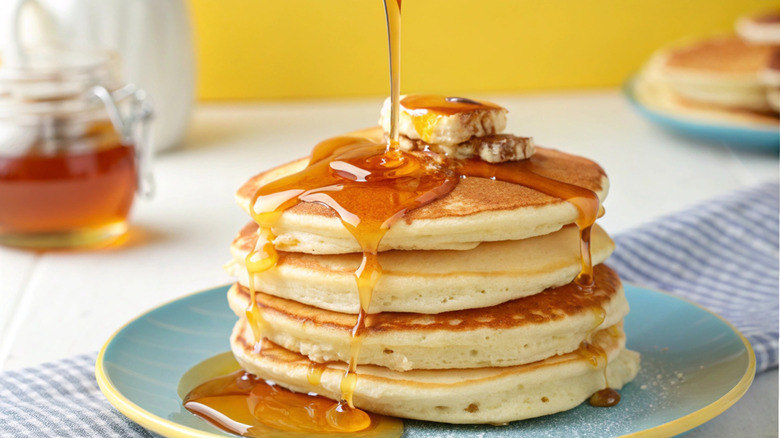
Diners are relics from the past that people still rely on for quick comfort food that almost never disappoints (though, of course, there are meals that you should avoid ordering at your local diner). If there's one thing that's consistently delicious, it's the glorious, cloud-like stack of pancakes — but why don't they taste as satisfying when we make them ourselves? To get into the nitty-gritty of it all, Chowhound spoke with Aurele Berdoz, director of food and beverage for Café Maud — which has two locations in NYC — to figure out why pancakes taste better at diners than at home. The secret lies in the ingredients and equipment. " ... Using buttermilk is essential to get that signature flavor and fluffy pancake, as it creates a chemical reaction with the baking soda," Berdoz explains. He adds, "Also, whipping the egg whites into stiff peaks and folding them into the batter mixture adds air pockets that create a soft and lifted pancake."
Berdoz also suggests using a griddle — an unexpected upgrade for delicious pancakes — as it's much better compared to a nonstick pan in this scenario. " ... A well-seasoned griddle ... provides an even heat distribution and [enough] space for uniform pancakes to help create that signature diner pancake stack look," he says. A griddle is also the key to achieving the toasty fringe we all know and love without affecting the pancakes' fluffiness, and it's a less messy alternative when it's time to flip them over.
How to recreate a diner-style batch that's perfectly soft and sweet
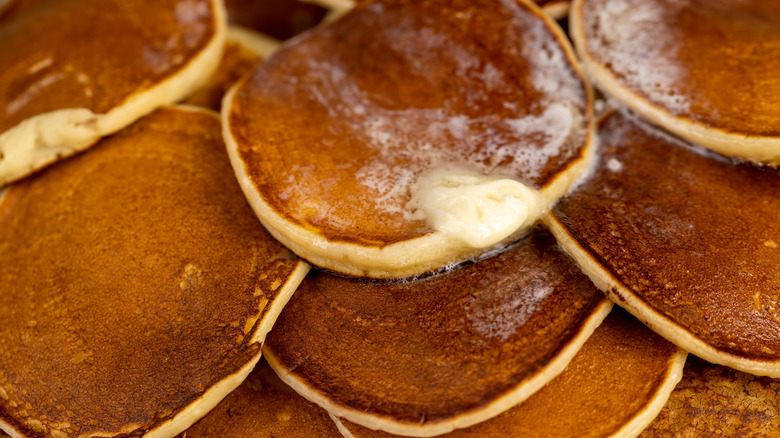
Just as you would after a tiring day, make sure to let the batter rest. Not doing so is a mistake that will ruin your pancakes. "This allows the gluten to relax, making the pancake have a tender texture," Aurele Berdoz informs us. He says that the sweet spot is between 10 and 30 minutes, though you might want to lean towards the latter if you have buttermilk and baking soda in the equation; when these two mingle, it permits a fluffier bite as a result of a CO₂ reaction. You can make use of a single-acting baking powder to speed up the process and still get a pillow-like texture as you let CO₂ work its magic. In this case, you'd skip the resting phase; otherwise you'd end up with flat pancakes.
If you don't have a griddle, Berdoz says, you can make another type of pan work by adjusting the temperature. Using low to medium heat helps the temperature distribute evenly across the pan. Butter or oil is your best friend for maintaining diner-style, lightly seared edges, so allow it to coat your cooking surface before you toss in the batter. Finally, give your pancakes plenty of space as they cook so that they come out as uniform as possible. By the end of it, you'll have the perfect batch, one you can make any time the craving hits for that diner-style spin on the classic breakfast favorite.