

What Are The Best Mason Jars To Use When Preparing Fermented Foods?
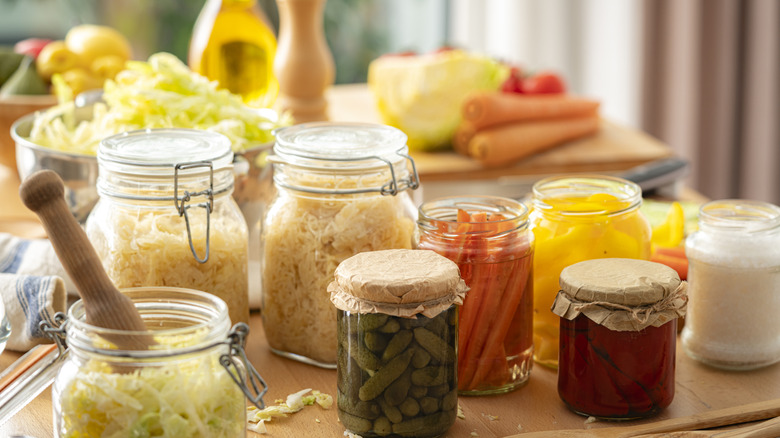
Mason jars are fascinating, chameleon-like household items that work as a vase, a mug, and even storage for almost any kind of dish you have in mind. Whether you're using them for meal prepping (it's the genius way Martha Stewart utilizes Mason jars) or brewing fermented foods, they can be your ride-or-die in the kitchen — as long as you use the right size, shape, and so on. To that end, Chowhound spoke with Marisa McClellan, creator of Food in Jars, a website dedicated to canning, pickling, and home preserving recipes, to figure out the best kind for all your fermenting projects.
"The size of the Mason jar really depends on what you're making," she exclusively told us. For instance, 16 ounces can work when you're making hot sauce (fermentation is the flavor powerhouse technique hot sauce needs) in a modest serving. Meanwhile, McClellan recommends using a half-gallon jar if you're making sauerkraut with four to five pounds of cabbage. The shape also comes into play. "I find that wide-mouth jars are almost always better for fermentation. The larger mouth allows you to really pack the veg into the jar, and many fermentation accessories are designed to fit wide-mouth jars," McClellan advises. As far as putting light pressure on your ingredients goes, which keeps them soaked in brine, using a quarter- or half-pint jar does the trick without the need for fermentation weights. This size fits perfectly well inside wide-mouth containers, from pints to half-gallons.
A clever Mason jar trick that actually works
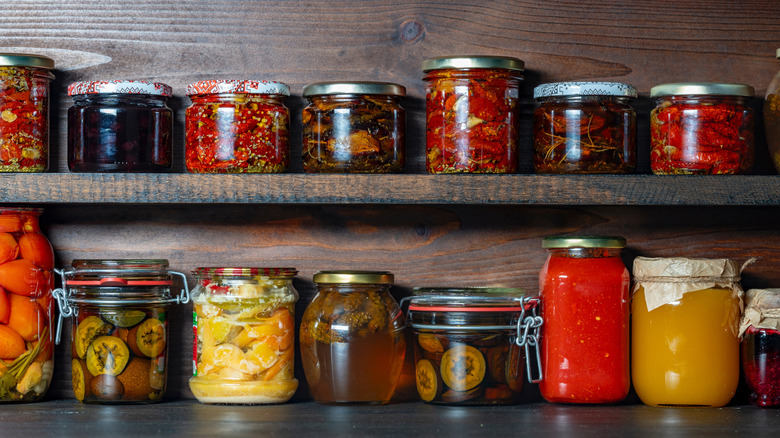
Having something like a waterless silicone airlock when fermenting is surprisingly not a be-all and end-all rule, though it can be a worthy addition to avoid creating conditions for mold to grow. Marisa McClellan has a cheat code, and all you need are two jars of varying sizes; the bigger one for the actual fermentation project and the smaller one for the extra brine. "The reason I use leftover brine is because if the liquid leaks into the primary vessel, it doesn't dilute my brine," McClellan explains. She then places the more compact jar at the mouth of the larger variant, covering it with cheesecloth and sealing everything in with a rubber band. Undyed cotton cloth or something more readily available, such as multi-ply paper towels, can also work well here (but paper towels need to be changed out once they've absorbed too much liquid).
There are storage mistakes that could ruin your food, so make sure to keep it out of light and heat. As a bonus tip, be wary of where you buy your Mason jars. Stores selling household items and cookware are your best bets. McClellan told us how she buys hers from a local sandwich shop, so if you have one near you, it's worth checking out.