

Chili Isn't Actually A Soup. Here's Why
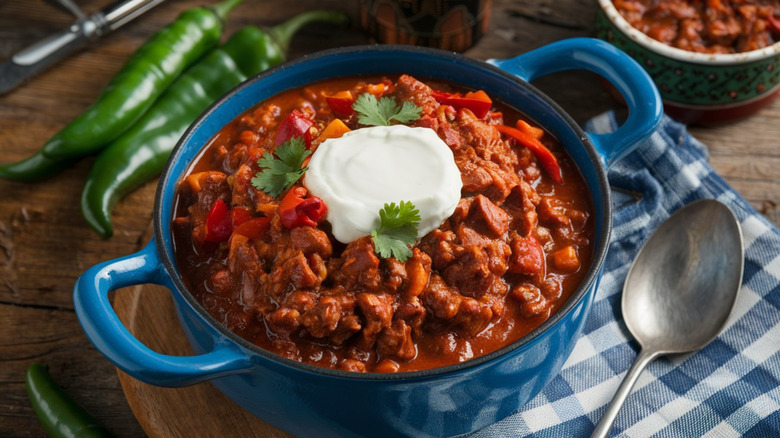
Chili is one of those dishes that defies being pinned down in terms of a standard recipe or classification. For instance, classic Texas-style red chili doesn't have beans, while hundreds of other chili recipes rely on beans — black, white, pinto, and otherwise — as a main ingredient. Meanwhile, Oklahoma-style chili comes in many different forms, from spicy with beans to mild without. The only thing most chili recipes have in common is the presence of tomatoes, a touch of heat, and tasting delicious with a side of cornbread.
Then, of course, there's the matter of where chili falls in the greater culinary zeitgeist. Some argue that chili and hamburger soup are the same thing, but they aren't — not really. While there's some overlap in ingredients and flavor profile, properly made chili generally falls into the category of stew rather than soup. Of course, this opens up debate about what the actual differences are between soup and stew, which is a thorny subject on its own.
For one thing, soups have a looser, more liquid consistency than thicker, richer stews— mainly due to the technique used to cook them. Soups are simmered in an open pot while stews are (predictably) stewed in a lidded one. Since chili is well-known for being cooked low and slow in a closed pot (sometimes for several hours or even all day in order to help the flavors blend), this places it firmly in the broader category of stew, not soup.
More things that set chili and soup apart
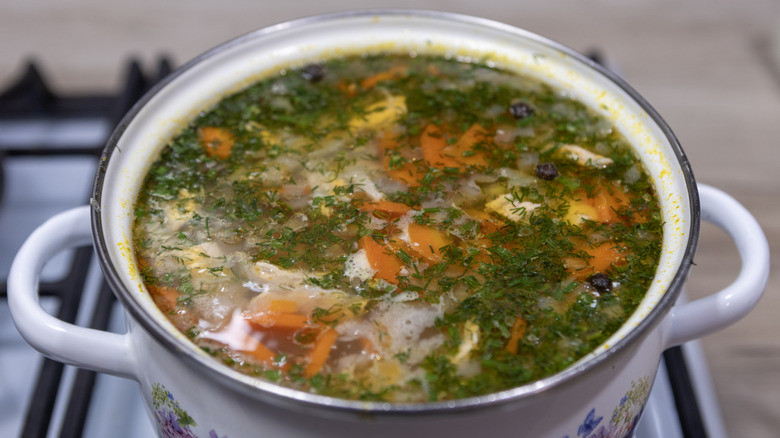
Something that differentiates chili from soup is the consistency. While most soups feature a range of ingredients suspended in a flavorful broth, the ingredients in chili tend to blend and meld together to create a suspension that's somewhere between gravy and sauce. You need a spoon to eat it without making a mess, but you can't sip at it the way you can soup. That's because more liquid is added to soup than chili.
The ingredients in soup need enough liquid to gently move around and occasionally meet each other during the simmering process, while chili and other stews only need enough liquid to cover the ingredients. Simmering also softens ingredients much faster than stewing, meaning different ingredients are better suited for soup versus chili. For instance, delicate veggies like zucchini, gooseneck squash, and baby spinach are frequently used in soup, but would get mushy and disappear in chili.
Conversely, cubed beef shank and starchy legumes are perfect for chili, as they need plenty of time to soften and become tender. It seems a little paradoxical to include peppers and tomatoes in chili, but these ingredients add so much flavor that it's okay if they melt down into the rich sauce, as you'll still be able to taste them. Chili can also be spooned over buttermilk biscuits or a jacket potato for a hearty meal, while soup is too thin and better enjoyed with crusty bread or crackers.