

The Layering Rules You Need To Follow For Structurally Sound Casseroles
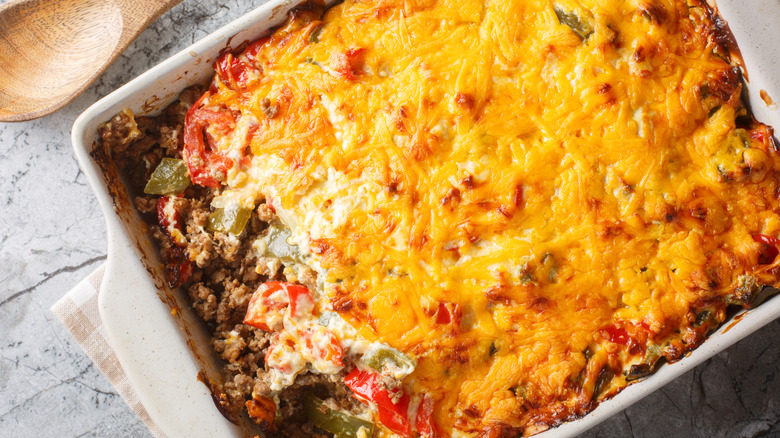
A casserole is an amalgamation of satisfying ingredients resulting in a perfectly hearty baked dish best enjoyed when shared. Layering is key for a full flavor burst, though that doesn't mean you can just toss everything in arbitrarily; it still requires some careful thought to make it truly structurally sound. Chowhound spoke with Tara Bench, cookbook author and blogger at TaraTeaspoon.com, who shared some exclusive foolproof layering tips for a craveable casserole.
"Weightier proteins and starches (think chicken, beef, or pasta) typically go on the bottom of the dish because they need steady heat and have more structure than other ingredients," she says. "To keep it structurally sound, make sure any starches are at least partially cooked before adding to the dish so they don't absorb loads of sauce." Make sure not to go heavy on the sauces, too — a balanced amount makes all the difference.
Meanwhile, veggies and sauces should be in the middle to keep them from getting burned. This also helps sauces spread better so the flavor is present in every spoonful. Of course, good food is more than flavor; it's also about texture. Separating sauces from crispy ingredients to avoid a soggy bite is crucial. Whether you're incorporating the frozen breakfast favorite that's a perfect casserole topper or opting for classic additions, such as breadcrumbs, they should be sprinkled on top. Toppings aren't just there as flavor boosters either; they're the glue that keeps everything from falling apart.
How to guarantee a successful casserole
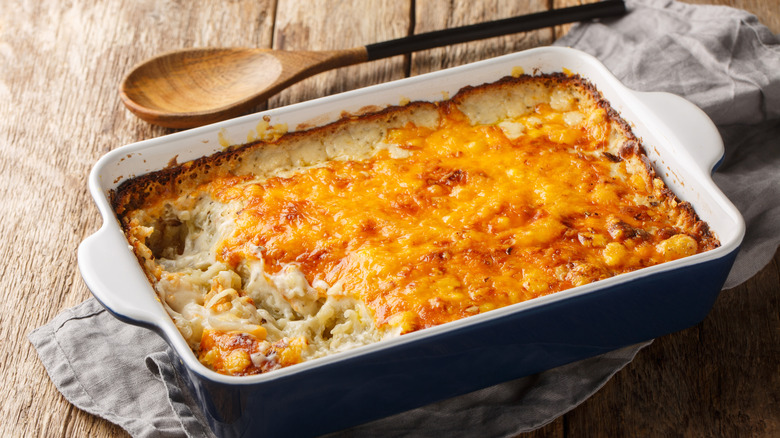
Beyond being smart about layering the ingredients, quantity also matters. As mentioned, don't be too generous with your sauces (or any liquid for that matter). Don't be too modest about it either, or else your casserole may be dry and perhaps lack flavor. It should be damp, not drenched. For the perfect ratio, Tara Bench gave some great guidelines to follow: "Balance a casserole with a rough ratio of ⅓ protein, ⅓ starch like pasta, rice, or potatoes (even tater tots!), and ⅓ vegetables." While it might be tempting to go all out with your favorite pasta, it's best to save the extra serving for another meal.
But don't just focus solely on the ingredients and forget about other important elements. The right vessel for your creation should also be considered since using the wrong kind of dish could ruin your casserole. Something made out of glass or ceramic is best for evenly cooked ingredients. It also keeps your food warm for longer. When your dish is finally done, don't take a bite just yet; before you start your feast, give it a few minutes to let it cool down and let the flavors meld even better.