

It's Always OK To Send A Dirty Dish Back At A Restaurant
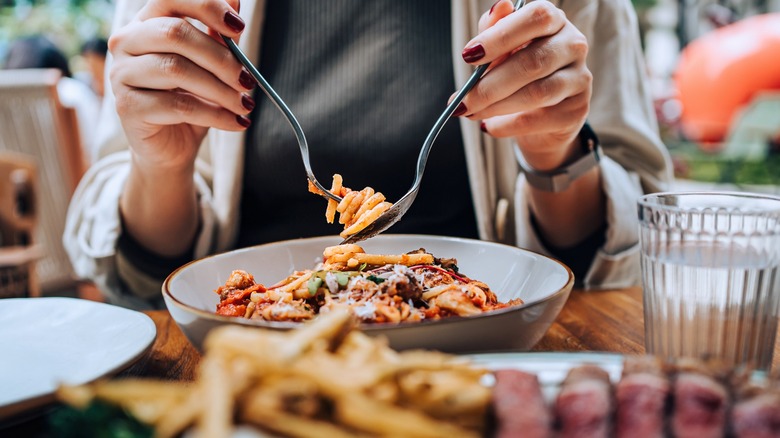
A customer and their server at a restaurant have a very unique relationship. On one hand, you want to make a good impression as a customer and not carry yourself or order in a rude way — which is why it pays to be aware of dining etiquette differences depending on where you are. But on the other hand, you're shelling out money for your dining experience, so you're perfectly within your rights to expect to be treated well in return. This extends to any problems that may arise with your food, including the dish that it's served on. But as far as addressing this issue is concerned, experts advise you to approach things tactfully.
It's safe to say that Dr. Frankie Weinberg is well-versed in restaurant customer relations. He is not only a Professor of Management at Loyola University New Orleans, but he is also the co-owner of New Orleans' Pomelo and Good Catch restaurants, as well as principle consultant for Leading Consultation International. Dr. Weinberg spoke exclusively with Chowhound about the etiquette that follows receiving a dirty dish, and said that customers should be direct but calm with their server. "I suggest discussing it with your server discretely," he said. Dr. Weinberg explained that, even with the most rigorous dishwashing equipment, one poorly-washed plate is bound to slip through the cracks occasionally. "Any place I know would replace it apologetically and immediately," he said. You don't need to be at a restaurant reputed for its service for this one, and your server will likely sympathize with your issue.
When should you send a dish back?

When is it appropriate to send a dish back to the kitchen? It's certainly a priority of a restaurant's staff to keep its customers satisfied, but it's impossible to know (let alone match) the expectations and tastes of everyone. It's a hazy gray area where Dr. Frankie Weinberg situates his advice.
"If the meal is incorrectly prepared, does not meet the specifications that were clearly communicated to the server regarding allergies or other restrictions at the time of ordering, or if the food is otherwise objectively unsafe to eat," he said. "These are situations when it is absolutely appropriate to send food back."
However, there are also times where it's absolutely not appropriate to return a dish, according to Dr. Weinberg. "If a dish is just prepared differently than you expected or doesn't match your personal taste, or if you changed your mind about a dish, it is not appropriate [to send it back to the kitchen]." In any event, it pays to be communicative with your server and ask questions if you have them. That way, you can ensure that you get a dish that suits you — and that your server doesn't get into a sticky situation with the kitchen staff.
How should you ask to have a dish sent back?

As much as you may try to avoid it, you're bound to come into a situation sooner or later where you'll be tempted to send your dish back to the kitchen. This could be due to a strict problem as Dr. Frankie Weinberg mentioned, but it could also be from a plain old mismatch between you and your dish. In either instance, Dr. Weinberg strongly advises against making a scene of things at the restaurant, implying that your server will appreciate it much more if you approach the situation with some tact and decorum.
"In the event of an incorrectly prepared dish, the best way to bring this up to a server would be to call them over to your table, and bring up — in a kind, collected, manner — the specific issue," he says. He continues by saying to "be very clear about what specifically is incorrect about the dish, so that the server can work with the kitchen to make it right. They really do want to!" As far as other problems go, such as simply not liking what you ordered, there may be more variation from one restaurant to another. Dr. Weinberg suggests that when you have a subjective issue, you should still communicate it clearly and ask for another dish, remembering that you might wait based on the kitchen's busyness. However, it would never hurt to see what can be done to address the problem. Besides — you never know unless you ask, especially if you've been exceptionally kind with your server.