

Can Hatch Chiles Be Frozen?
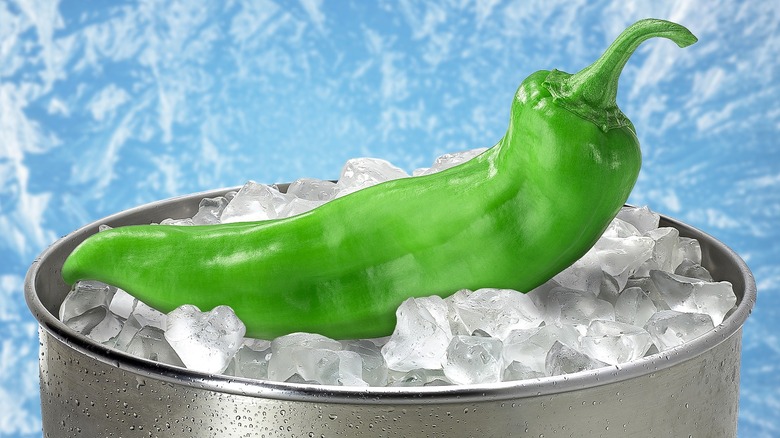
Whether you first heard about the New Mexico delicacy after trying Trader Joe's Hatch chile mac and cheese or you've been in the loop all along, you know by now that this versatile pepper is a great addition to all sorts of dishes. It has varieties that range in spice level from totally mild to pretty spicy (it can hit 8,000 Scoville Heat Units, the equivalent to a jalapeño). So if you're scheming to prep a batch of your own Hatch chile mac, or want to be able to use them to flavor some other dish even when they're out of season, you might be wondering — can Hatch chiles be frozen?
The answer is yes, but there is a specific process you should follow to ensure they retain their flavor once reheated. First, blister the chiles on very high heat, making it easier to slide the skins off. Once they're peeled and cooled to room temperature, the peppers can be tightly packed in gallon or quart-sized plastic baggies so that you can ration your supply over time, vacuum sealed, and immediately placed in the freezer. And there you have it: chiles that can be eaten for the next 12 months, all the way until the next harvest. Our hack? Skip the time it takes to roast the chiles at home, and buy them in bulk pre-roasted so that all you have to worry about is the freezing process.
Details of the freezing and reheating process
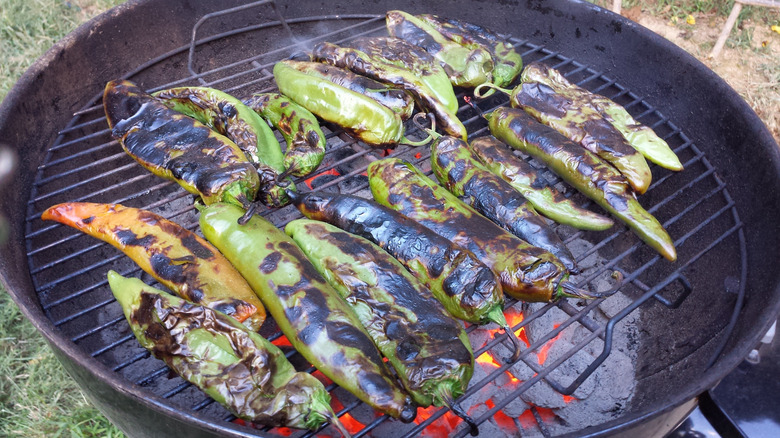
When you're packing your chiles away for the season, there are a couple of things you should keep in mind to make sure everything goes smoothly. The first tip? Choose good produce. You'll want to go for peppers with smooth skin and avoid any mold, soft spots, or excessive bruising. These will likely go bad faster than fresh, unmarred veggies, and although freezers slow down the growth of mold, they don't entirely stop it — so your whole bag of chiles could easily become contaminated by one bad egg.
Of course, what comes up must come down — and what is frozen must inevitably be reheated. So what's the best way to go about reheating Hatch chiles once they've been packed away? First things first, let them sit on the counter for a little while to begin the defrosting process. After that, you can continue defrosting them on the counter or in the fridge, or if you're in a time crunch, go the microwaving or air frying route to get your chiles to warm up in a hurry. The general rule for reheating leftovers is that if a food has a lot of moisture (think soup or pasta), it should be microwaved; if it's crispy, it should be air-fried. Depending on what you want to use the chiles for, either method can work.
Check the peppers after reheating them before adding them to your dish for sliminess, discoloration, or any other sign that something went wrong in the freezing process. And if all that defrosting time sounds like a little too much for you? Go a little out of the box and try grating the frozen chiles straight onto your dish.