

Walmart's Dicey Egg Dealings Might Send You Elsewhere To Shop
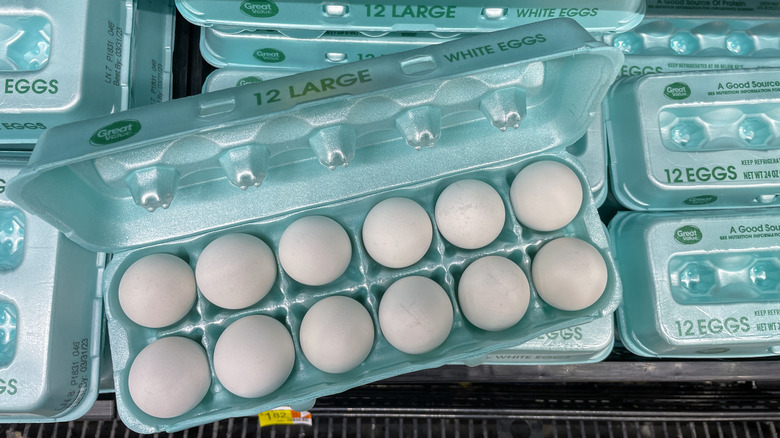
Walmart is famous as an all-in-one stop shop, offering anything from groceries to clothes, home furnishings, and everything in between, all at low prices. Even with its success, it's also had its share of controversy concerning its operations and how it does business. One came as recently as seven years ago concerning its eggs being organic. Certainly, consumers pay a premium cost for organic products, thinking they're doing something good for the world and themselves, since something labeled "organic" must adhere to certain USDA requirements. But further investigation into one of Walmart's major organic egg suppliers uncovered some shady dealings.
In 2018, California resident Donnie Lee Gibson led a class-action lawsuit after buying organic eggs from Walmart. The suit complained that the eggs were knowingly and misleadingly labeled as "organic." Gibson's attorneys, Hagens Berman Sobol Shapiro LLP, attested that, upon investigating its major egg supplier, Cal-Maine Foods, less than 1% of the chickens weren't even able to see the outside world. Instead, they were kept in an enclosed facility that had the capacity for 400,000 hens. However, at the same time as the suit was submitted, the USDA withdrew its consideration for the Organic Livestock and Poultry Practices (OLPP) rule, which would have promised livestock access to the outdoors and set a minimum standard for their quarters. Its removal may have allowed Cal-Maine's operations to be acceptable, which could have put a wrench in Gibson's case. Interestingly, there is no evidence of its status as either ongoing or settled.
Walmart's eggs aren't the only organic product under scrutiny
Naturally, cases like those brought against Walmart's organic products raise the question of what "organic" actually means in the food world. In short, although there is no minimum size requirement for an organic livestock housing facility, organic livestock farms must adhere to other regulations: the animals must have access to direct sunlight, be able to roam freely, and be free of antibiotics and growth hormones. There are also other standards, such as the livestock's feed being 100% organic, and that they have year-round access to the outdoors. To help prevent organic products from raising too many red flags on their food labels, the National Organic Program helps set these rules, which the USDA enforces.
While the status and future of the case against Walmart's organic eggs is uncertain, it's not the only one Hagens Berman Sobol Shapiro has submitted against their organic products. In 2008, the law firm led another class-action suit against Aurora Dairy Corp., Organic Milk, a major dairy supplier for Walmart and other grocery stores. The suit was settled in September 2012 for $7.5 million with a reimbursement requirement by mid-2013. Similarly, a separate lawsuit was submitted by another team of attorneys in 2023, alleging that Walmart's Great Value organic raw honey is also falsely advertised as both "raw" and "organic." This is because the honey was exposed to high heat during processing, which means it isn't raw. It was also found to contain too much industrial sweetener, which makes the honey non-organic and possibly places it among other Great Value products you'd want to avoid in your cart.