

The French Origins Of The Show-Stopping Seafood Tower
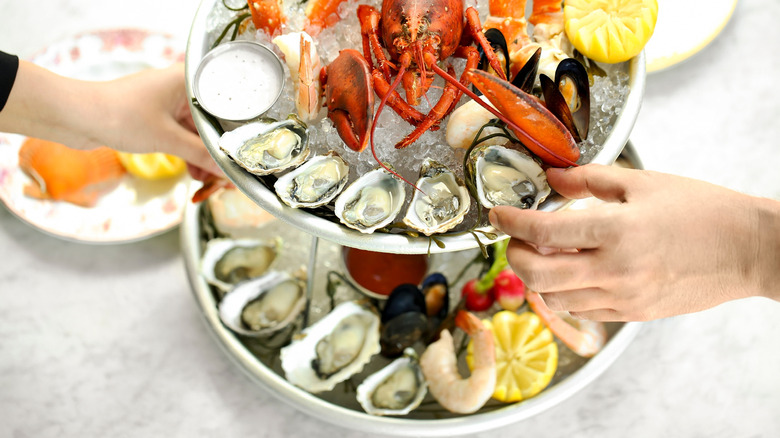
Imagine sliding into a tiny brasserie table in Paris. A server sets down a silver stand piled with shellfish on crushed ice, oysters at the base, and pink shrimp and lobster claws at the top. In France, this is a plateau de fruits de mer, which translates to "platter of fruits from the sea," and was popularized in the 19th and 20th centuries. However, the practice dates back to the opulent lifestyle of 17th-century aristocrats. Cooks build up rather than spread out, and the stand saves room, adds a dramatic flair, and keeps the cold seafood above the chill of the ice.
That Paris platter is the blueprint for the American seafood tower that you may be familiar with. The ingredients overlap, with oysters, shrimp, crab, lobster, and clams present. However, the difference is scale and theater. In the United States, steakhouses and raw bars leaned into height and spectacle, sometimes with dry ice fog and a variety of sauces, which turned a platter into a centerpiece. If you remember seeing towers appear on big-city menus in the 2000s, you are not wrong; the format arrived after the French idea had already lived for many years. That is why it feels familiar whether you are navigating what to eat aboard a cruise, discovering a simple seaside town with great oysters, or dining at Anthony Bourdain's all-time favorite Paris restaurant. But while this covers the look and feel, the varieties of the seafood spectacle are also worth a closer look.
Seafood as it spreads across regions
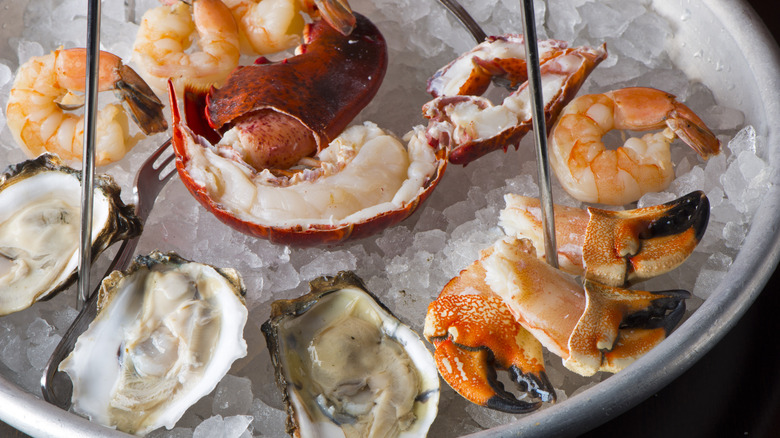
Food history rarely has a single starting line, and seafood towers are no exception. France gives us the platter, the stand, and the ritual, but other traditions float around the same ballpark, albeit with different styles. For example, Portugal's mariscada is not a tower, but instead a heaped seafood stew that celebrates variety on one plate. Similarly, Italy's antipasti di mare sends out chilled seafood as an appetizer. All of that context makes sense of the present. The tower itself feels French in service, yet it speaks to a broader habit of piling food onto a shared dish and letting diners mix seafood with lemon, salt, and cold brine to taste.
Details also shift by place, which is part of the fun. In France, you are likely to find mignonette and brown bread alongside your oysters. In the United States, you are likely to see cocktail sauce, drawn butter, and a flashlight-wielding server showing off the tiers. Brasserie culture in France might be one of the first to adopt the seafood tower, but today, many high-end restaurants all over the world have embraced the tall stack for maximum table impact. If you want a clean takeaway, though, you can keep two ideas at once. The seafood tower is anchored in the French plateau de fruits de mer, but it also belongs to a wider family of shellfish feasts that different coasts have made their own.