

Don't Have A Springform Pan? This Hack Will Give You The Second Best Results
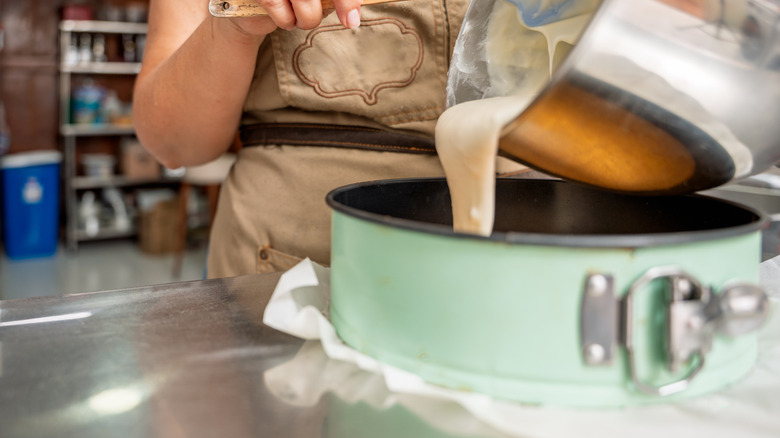
If you're not sure what a springform pan is (and whether you need one at all), you're not alone. Many home bakers have heard the term tossed around, but aren't entirely sure what their fellow culinary artists are talking about. Simply put, a springform pan is a baking dish with two parts: a flat, circular bottom piece that fits neatly inside a tall ring with a latch that forms the sides of the pan. When the latch is opened, the sides of the pan "spring" apart to reveal the perfectly flat, straight edges of delicate baked goods like cheesecake or Italian flourless chocolate cake.
Of course, if you don't bake delicate items often, you may not have a springform pan laying around when you get the urge to make a delicious honey-apple crumb cake, custard tart, or a savory dish like deep-dish quiche or lasagna al forno. The good news is that you're not out of luck. Though a springform pan may be the easiest way to cook these items and help them keep their shape, there are ways to replicate the effect of a springform pan without needing to make a trip to Williams Sonoma.
The simplest method is to line an ordinary baking dish with parchment paper and bake your recipe as normal. Press it firmly into the corners to ensure your results are the right shape, and leave some paper sticking up from the edges of the pan so you can smoothly and easily remove your dessert.
Proper parchment paper placement for springform success
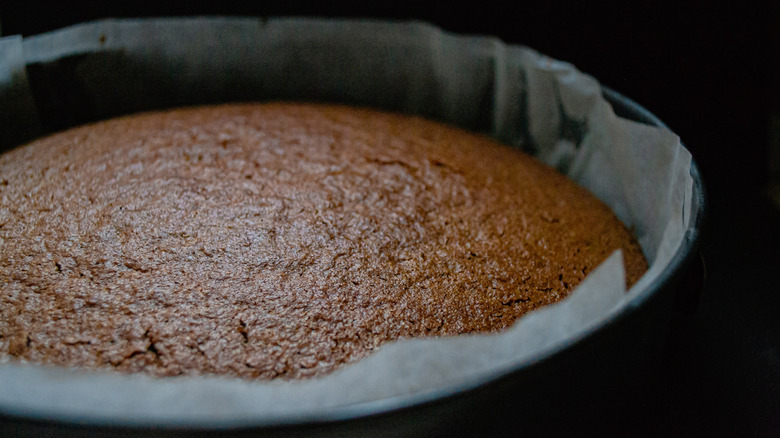
As mentioned, the key to turning a regular baking dish into a makeshift springform pan is parchment paper pressed carefully into the bottom of the dish. This creates a smooth, sturdy barrier between your pastry and the baking dish that allows you to simply lift your baked and cooled creation from the dish and set it on a serving platter. You'll then need to gently pull the parchment paper away from the sides of your pastry and slowly slide the paper out from under it.
Since parchment paper is smooth, this should be relatively easy, provided you use enough parchment paper to leave some projecting upward past the edge of your baking dish. This extra margin of paper is the key to making this hack work — without it, you won't have anything to grip as you lift your baking efforts from the dish. Some home bakers may also suggest making an X with strips of paper that travel up the sides of your dish and stick up like little pull tabs. However, this method concentrates the pressure of pulling to specific areas and may disrupt layers, break crust, or ruin sponge.
Whether you decide to try the strips or use full sheets, it's also important to note that this method likely won't yield baked goods with a perfectly smooth outer layer. Instead, they'll have ripple marks from the parchment paper, which might be covered by frosting, sauce, or passed off as an elegantly rustic presentation.