

Give Homemade Donuts Pillowy Soft Layers With This Technique
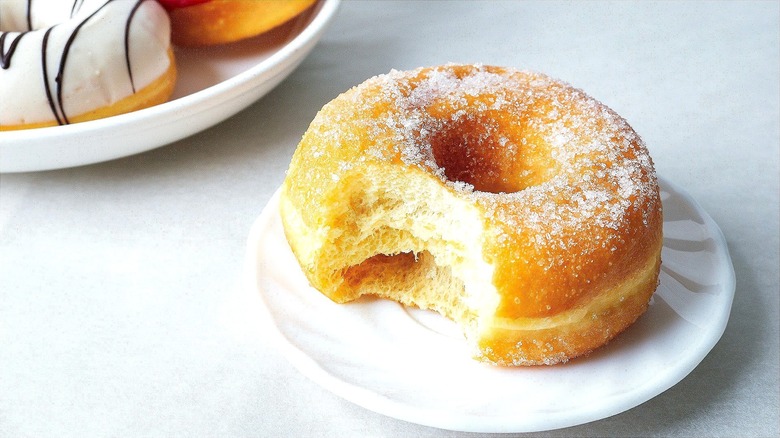
If you enjoy croissants for their flaky, buttery texture, you may be wondering how you can give your next round of homemade donuts the same worthwhile appeal. Fortunately, with one specific preparation technique, you can succeed in giving your next batch of donuts fluffy, irresistible layers. All you need to do is laminate your donut dough. Donuts made with this specialized technique are often referred to as layered donuts or cronuts.
Sure enough, cronuts, which are hybrid delicacies that encompass characteristics of both croissants and donuts, are easily one of the wildest croissant trends out there. Essentially, buttery croissant dough is shaped into donuts, fried instead of baked, and topped with various extras like frosting, sugar, and sprinkles. Though, what makes these one-of-a-kind confections particularly similar to croissants is the lamination process.
Since butter is the secret to making flavorful, bakery-style croissants at home, you need just as much butter to make fluffy layered donuts. More specifically, lamination involves rolling out yeasted dough and then layering the dough with softened butter.
As demonstrated in the video below, to make layered donuts, start by adding cold butter to pliable croissant dough. From here, strategically roll out your dough, tri-fold it, and then repeat this two-step process an additional five or six times before shaping your donuts.
@50.shades.of.bread Got my hands on some nice butter ❤️ makes lamination easier. Same pastry cream batch used from the creme brulee donuts, it keeps well in the fridge for about a week. Pastry Cream: 1/2 Vanilla Bean 1/2 Liter Milk 1/4 tsp salt 120g Granulated Sugar 4 Tbsp Cornstarch 2 Large Eggs 50g Butter (unsalted) Add milk and salt to a saucepan, and heat on medium/high until nearly boiling, stirring frequently. In a separate bowl, whisk eggs, sugar, and cornstarch until smooth. Slowly add 1/3 of the hot milk to the egg mixture while whisking, then pour back into the saucepan, continuing to whisk. Heat and continuously stir for 2-3 minutes until thickened. Move to a clean bowl through a fine mesh sieve. Let cool for 5-10 minutes, whisking occasionally. Add butter in 10g pieces and whisk until dissolved. Transfer to a shallow dish, cover with plastic wrap, and refrigerate for up to 1 week. Croissant dough 300g Bread flour 200g all purpose flour 220g Whole Milk 350g poolish (see below) 13g Salt 40g Sugar 5g active dry yeast (1.5tsp) 220g Butter (unsalted) for lamination Poolish: This is yeast, flour and water mixed and fermented before you add it to the dough. 175g bread flour 175g water (warm, not hot) 3g yeast (1tsp) Mix and ferment for 2 hours at room temperature or overnight in fridge (preferred) Method: In a large bowl add the milk, warm it up for 30 seconds on high in the microwave. Add poolish and mix to combine. In a separate container, add flours. If your starter/poolish are from fridge, warm up the flour in the microwave for 30 seconds. Add salt, sugar, yeast, stir to combine. Add flour mixture to the large bowl with the milk mixture, and stir with a fork until shaggy mess forms then use wet hands to knead the dough in the bowl. Wet your hands several times while kneading. Optional proof: Move the dough to a clean bowl and let proof in warm area for 30 minutes. Stretch and fold the dough into itself several times and let it proof for 30 more minutes . Repeat the folding process. flatten the dough, wrap and place in freezer for 3 hours. Prepare your butter block : Flatten 200 g of butter inside the sheet of parchment paper. Use rolling pin to flatten it to 0.5-1cm. Let the butter block cool in fridge for 30 minutes before lamination. Flatten the dough on a floured surface . Place the butter block in the center and fold the dough on both ends to seal the butter inside. Roll out the dough to about 1-2cm thick. Fold each end toward the center. Then fold again like a book. Place in freezer for 20 minutes. Roll out the dough back to 1-2cm thick. Fold the dough into thirds this time. Wrap and place in freezer for 2 hours. You can also let it freeze fully and defrost overnight in fridge. #food #asmr #croissant #pastry #custard #recipe #fyp
This somewhat lengthy process is what gives you buttery-soft layers within each pre-formed donut. However, before you attempt to tackle this technique at home, there are a few important tips you should keep in mind.
How to successfully make layered donuts at home
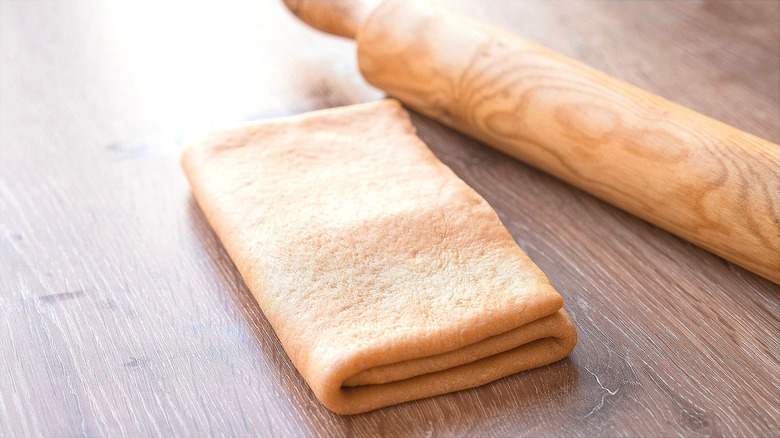
Whether you're making round donuts or muffin-shaped, donut-like confections, allowing your dough to rest before cooking is essential. Truth be told, the process of making layered donuts takes roughly two to three days to complete.
First, allow your initial dough recipe to rest and slowly rise in your refrigerator for at least 24 hours. Then, when you're ready to laminate your dough, beyond the rolling and folding, give your pre-formed donuts time to rest and rise (once more) before frying. Additionally, for donuts with perfectly distinct layers, pay attention to the temperature of your ingredients during the lamination process.
Roll cold dough straight from the refrigerator and aim to keep your butter chilled and firm. While this may seem tricky since you'll be re-rolling your dough again and again, all you need to do is prep the butter in advance. Simply place the suggested amount between two sheets of parchment paper and flatten it with a rolling pin. Keep flattened butter refrigerated until you're ready to incorporate it into your dough.
Lastly, to make confections that are more similar to donuts as opposed to croissants, fry your donuts in either an air fryer or in cooking oil on your stove. Only then can you cover these luscious snacks in all your favorite toppings. Dress your donuts with a powdered sugar glaze or a dusting of cinnamon sugar, or make a chocolate donut frosting with only two ingredients: oil or butter and chocolate chips.