

Here's An Easy Way To Spot Rotten Sushi And Save Yourself From A Stomachache
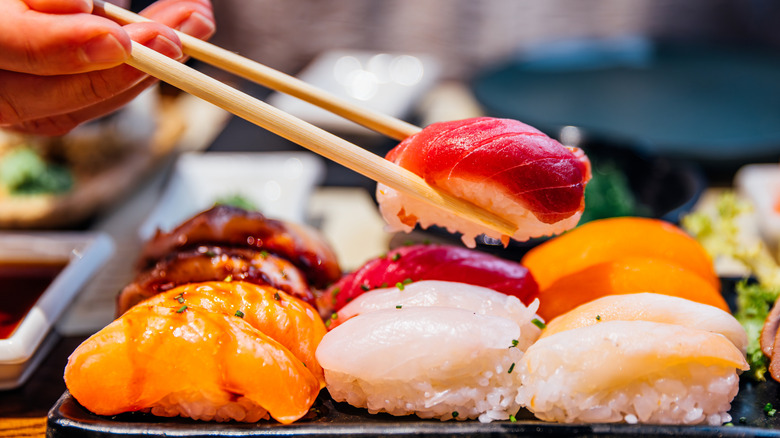
Despite the massive worldwide popularity of sushi, some skeptics are still put off by the idea of eating raw fish. Raw animal products in general can make people nervous, since the general advice is that they have the potential to make us sick via bacteria. Thankfully, most fish used in sushi has been flash frozen, making it perfectly safe (and delicious) to eat. However, there is little oversight to make sure of this, which is why some might choose to steer clear of less regulated sushi servers, like gas stations, entirely — and why everyone should steer clear of any sushi that appears rotten.
But how can you tell whether sushi fish has gone bad? As expert Namiko Hirasawa Chen, creator of Just One Cookbook (where you can find tips for making temaki sushi and sushi rice) and JOC Goods, exclusively told Chowhound, there are a few clear signs to look out for. One of the most obvious is its textural changes, which you can check using a simple touch test. "Texture is one of the clearest indicators of whether sushi or sashimi is fresh," Chen says. "When the fish begins to spoil, it often becomes mushy or limp, losing the natural firmness that fresh fish should have. You may also notice an unpleasant stickiness or sliminess on the surface, and in some cases, even a grainy or chalky texture as the proteins start to break down," she adds. If you notice any of these indicators, it's best to cut your losses and save your stomach.
More signs of spoiled sushi

Haven't had the chance to touch-test your sushi, or still unsure whether it's safe to eat? Nami Hirasawa Chen offers a couple more clear characteristics to check. One is its appearance — does the fish look fresh and vibrant, or dull, discolored, and dead? "Fresh fish has a natural sheen and vibrant color, with flesh that looks slightly translucent and lively," Chen says. "When it's no longer fresh, the color may appear dull, grayish, or uneven, and the surface can look dry or watery." Don't just look at the fish, either — if you're eating a maki roll, even the appearance of the nori paper, or seaweed wrapping, can clue you into its freshness.
As is the case with many perishable foods, another sign to look out for is the smell of the fish. "Fresh sushi and sashimi should carry only the faint aroma of the ocean — clean and delicate," Chen says. On the other hand, if it has a strong fishy or sour odor, it's worth avoiding. However, Chen does point out that there are a few exceptions to these guidelines. Some fish or other sushi ingredients may have a naturally "softer or stickier quality," and still be safe to eat. For example, she says, squid may feel a little tacky, while sea urchin is inherently creamy. "The key is to recognize what's expected of that particular ingredient," Chen says. "If the texture goes beyond its natural qualities... that's when it's a red flag."