

Is Curry Powder A Good Substitute For Curry Paste?
The subject of curry is a large topic, as there are many types of curry found throughout the world, all having their own unique spin and method of cooking. There are also different types of spice mixes used in curry, including various blends of curry powder and curry paste. You might wonder if you can use curry powder to replace curry paste if you plan to make the dish at home. Aom Srisuk, executive chef and owner of Good Catch Thai Urban Cuisine (@goodcatchnola on Instagram) and Pomelo in New Orleans, Louisiana, spoke exclusively with Chowhound to share her knowledge of curry, including whether or not curry powder and paste are interchangeable.
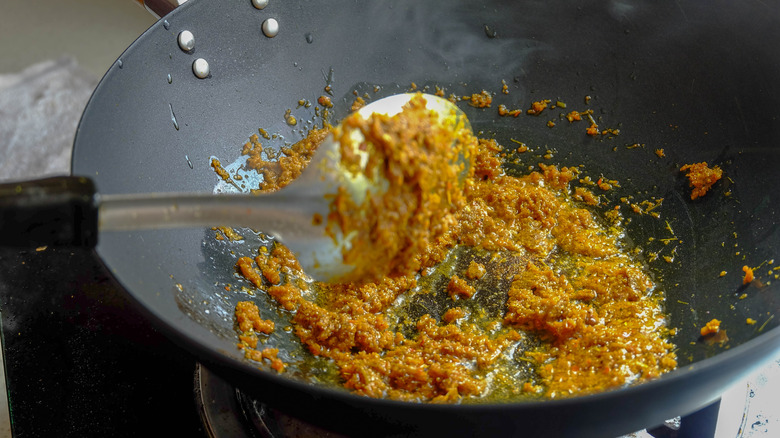
In short, according to Srisuk, there's no effective way to directly substitute curry powder for curry paste. "With Thai curry pastes, we often start by frying the paste in oil (or in some cases, heating coconut milk first, then stirring in curry paste). Curry powder would not be a reasonable substitute for this," Srisuk said.
Curry powder is a complex blend of spices, generally consisting of a blend of turmeric, coriander, cinnamon, cumin, black pepper, ginger, cardamom, and fenugreek. However, it comes in numerous varieties depending on the country it is from and even the household that prepares it. When used in Thai cooking, there's a big difference between powder and paste. "Curry powder is a blend of only dry spices. Thai curry paste includes a blend of fresh herbs (such as chilis, garlic, shallots, lemongrass, galangal, and kaffir lime leaf, etc.), pounded together with some dry spices," Srisuk explained.
Cooking with curry powder vs curry paste
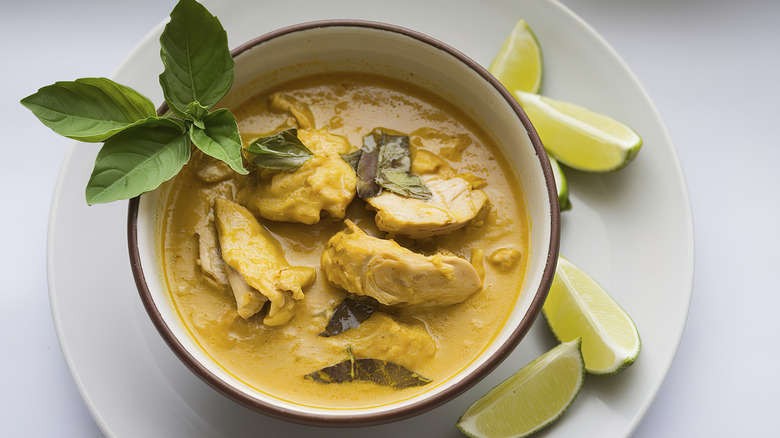
It's difficult to pin down what actually characterizes a curry because of its history as a European interpretation of spiced foods that came from colonized countries. Each region that makes curries has its own methods and variations, usually involving a stew-like dish made with meats or vegetables simmered in a curry sauce, such as the massaman and panang curries of Thailand. You'll find spice pastes in curries around the globe, though, from South Indian to Malaysian to Jamaican curries. And whatever curry you're making, it's important to know the difference between curry powder and paste.
Speaking of Thai cooking in particular, Aom Srisuk said, "In terms of flavor, curry paste tastes more fresh and vibrant because of the abundance of [its] fresh aromatic ingredients." The curry powder is just one component of the paste, and not even the most substantial one; fresh herbs comprise the bulk of the ingredients. "If you have on hand fresh garlic, shallots, lemongrass, galangal, and other elements of yellow curry paste, then you can pound those together with the curry powder to basically turn it into your own version of a curry paste," Srisuk explained.
As for how to work with curry powder versus paste, Srisuk said, "Curry powder is very finely ground and so, the way my husband and I use it is typically as a rub or part of a marinade ... Thai curry paste, on the other hand, forms its own base for many sauces." Ultimately, a clear understanding of the differences between the two will ensure you're always using the right ingredient for the job.