

Why Watermelon-Flavored Food Never Actually Tastes Like The Real Deal
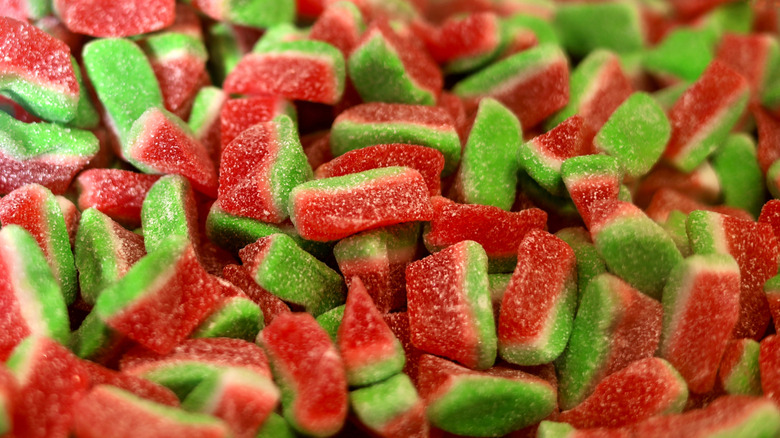
Cutting up a watermelon into crescent shaped slices and happily getting the juice all over you is peak summer ritual. The flavor is bright and light, with just enough sweetness and a thirst-quenching quality that hits the spot on a hot day. But why is it that whenever you buy something watermelon-flavored, the taste doesn't quite seem to match?
The answer has to do with the challenges of replicating nature's perfection with chemicals. In fact, the compounds that make up watermelon's unique flavor tend to break down very quickly and easily, making it impossible to observe them long enough to chemically reproduce structurally similar compounds in the lab. This means that flavor scientists are coming up with the next best thing — and though some people love it (who can happily rest assured that the artificial flavor likely won't be changing anytime soon), others are left dissatisfied and craving the real thing. It's not just watermelon-flavored treats that can leave consumers underwhelmed; many other fruit flavors don't really get the taste right either, and there's a reason for that.
Why most artificial fruit flavors miss the mark

Chemists began working on flavor compounds for candies that could mimic fruit back in 1860. What they came up with was a compound called isoamyl acetate, which served as a one-size-fits-all for fake fruity flavors. The same compound was actually present in bananas, just not the variety most of us are familiar with today.
Varieties of bananas have changed a lot over the years, for several reasons. In the 1950s, Gros Michel was the most prevalent variety, which contained isoamyl acetate. When Gros Michel bananas were wiped out by a fungal invasion, the ones that replaced them were Cavendish. Though scientists could likely now make a banana flavoring closer to Cavendish, the fact is that many are used to — and quite fond of — the original banana flavoring, so why mess with a good thing?
The same goes for other fruit flavorings that don't quite hit the mark, like cherry, which was made in the late 19th century and originally meant to match the flavor of wild cherries or cherry liqueur (this is where the maraschino cherry flavor comes from). Back then, cherry liqueurs were actually made with pits of cherries rather than the fruit. Cherry pits contain a compound called benzaldehyde, the same compound found in bitter almonds; this is why artificial cherry flavors often have a slightly pungent taste. Then, there's the ubiquitous artificial grape flavor, meant to replicate a variety called Concord, rather than the green and red ones we are used to today. Though all of these could likely be changed now, the one fruit flavor that remains elusive and impossible to recreate in a lab is watermelon, for better or for worse.