

Was President John F. Kennedy's Infamous Jelly Donut Speech Really All That Bad?
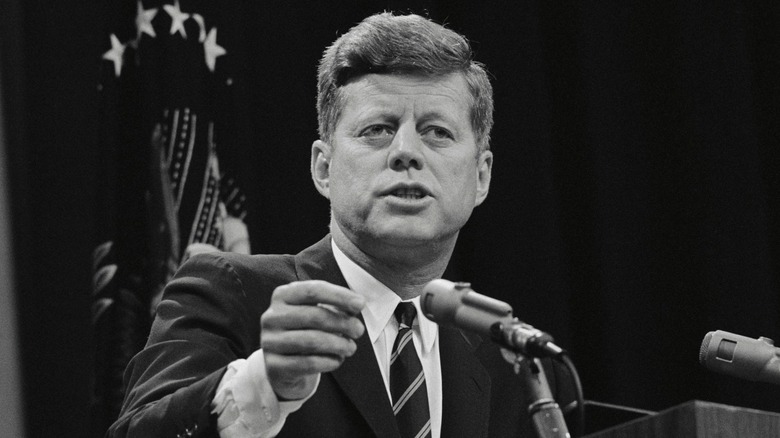
If you've ever tried to learn a new language, then you'll know just how easy it can be to slip up a word or two, potentially changing the whole meaning of your sentence. If it's any consolation, this exact situation can happen to even the most powerful people in the world. Take, for example, former President John F. Kennedy, who may have accidentally called himself a donut in a historic Cold War speech.
Kennedy was a Harvard University graduate raised by a wealthy family in New England (home of his go-to White House lunch, clam chowder). He learned to be a proud public speaker, and this gusto was on full display in 1963 as he delivered a speech near the Berlin Wall in West Berlin. Here, Kennedy proudly stated, "Ich bin ein Berliner," intending to say that he was a Berliner in solidarity with West Berlin. While the message landed, some German speakers found humor in the American president unveiling his "true status" as a jelly donut.
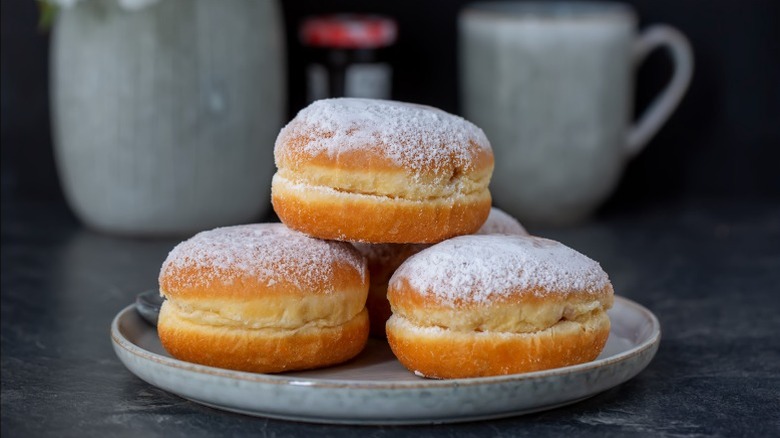
It's not uncommon for food items to fall under different names, depending on location. What you might know as a Bismark donut can have a different name based on the region of Germany, and one such name for the jelly-infused pastry is "Berliner." Ironically, the donuts aren't usually called Berliners in Berlin, but it's possible the broadcast of Kennedy's speech garnered a couple of chuckles from certain watchers (even if they understood what he truly meant).
What it means to be a Berliner
President John F. Kennedy caught a lot of flak for this "Berliner" incident, but interestingly enough, most of this criticism and mockery seemed to take place decades after the event. In the days following his 1963 speech, there didn't appear to be any real misunderstanding in what Kennedy was trying to say. The context of the situation made it clear that he was taking a firm and proud stance by standing with Berlin against the Soviet Union.
The translation concern is centered around the word "ein." In English, it's possible to use nationality as a noun or an adjective, so you might say "I'm an American" to announce that you're from the United States. In German, you would usually drop the indefinite article, leaving you with "Ich bin Amerikaner." The argument goes that Kennedy should've said "Ich bin Berliner," leaving little doubt in his status as a regular, non-jelly-filled being.
However, what he did say turns out to have been correct all along. Since Kennedy wasn't from Berlin, saying "Ich bin ein Berliner" conveyed that even though he wasn't a native Berliner, he was one in spirit by sharing the same values and beliefs. No matter how you spin it, this moment certainly didn't hurt in linking American culture and the popularity of donuts. This piece of history can offer a valuable lesson even today: Watch what you're saying so you don't end up making a donut of yourself.