

Don't Mistake Piloncillo For Brown Sugar. They're Not The Same Thing
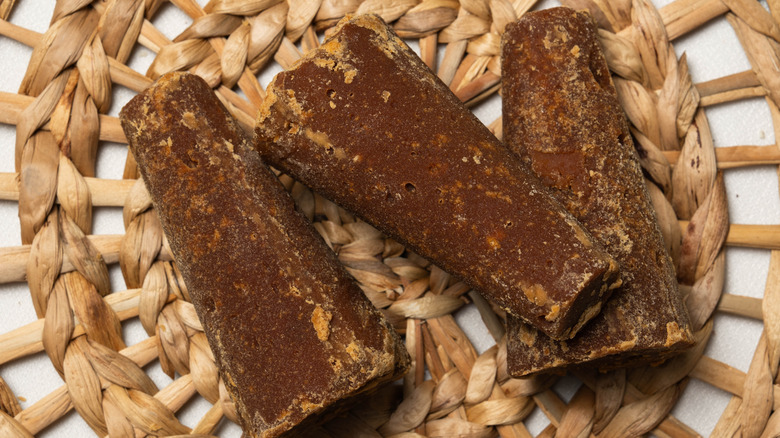
Unless you're particularly familiar with Latin American cuisine, you might see a cone of caramel-colored sugar and assume it's the regular brown or golden sugar variety you're used to. But there's a good chance you've actually come across a block of piloncillo, also known as panela (not to be confused with the semi-soft Mexican cheese of the same name). While piloncillo looks a lot like brown sugar — and they're both yummy, caramelized sweeteners — there are some key differences between these types of sugar.
Essentially, brown sugar is refined white sugar with added molasses, while piloncillo is an unrefined cane sugar (which is not the same as granulated sugar) made by boiling cane sugar juice and cooling it in molds. To know more, we reached out to chef Alam Mendez of Apapacho Taqueria in Washington, D.C., and he told Chowhound exclusively that the process of making piloncillo enables it to keep the minerals and molasses present naturally in it intact. "Because of this, it has a much more intense and layered flavor than commercial brown sugar," he says, "often with notes reminiscent of spices like allspice, anise, cinnamon, or even aged rum." In comparison, he adds, the flavor of brown sugar is "milder and more straightforward." There is a difference in piloncillo's texture and consistency, too. "Its texture is hard and dense, requiring grating or dissolving, unlike the soft, moist granules of brown sugar," Mendez explains.
Cooking with piloncillo
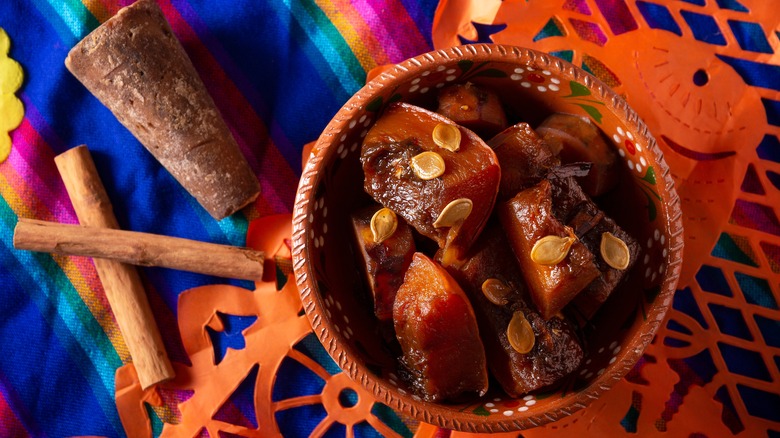
Piloncillo is a staple ingredient in Mexican cooking as well as in other Latin American cuisines. It's essential to many must-try non-alcoholic Mexican drinks like tascalate, tejuino, and champurrado, as well as a number of traditional Mexican sweets and even savory dishes. Chef Alam Mendez says, "In dishes like calabaza en tacha, mangos en dulce, capirotada, or café de olla, piloncillo doesn't just sweeten — it provides richness, depth, and aromatic notes that brown sugar alone cannot replicate." This is a key reason that piloncillo can't simply be swapped for brown sugar in many recipes, as it lacks the "warm, spiced character" of piloncillo, as he describes.
If you don't have piloncillo on hand, Mendez says, "Regular brown sugar can work in a pinch, but darker, less refined sugars like dark brown sugar or muscovado are better substitutes because they carry more molasses and complexity." You can usually use a one-to-one ratio to swap, but Mendez also suggests making a syrup with dark brown sugar and using spices to infuse piloncillo's spicy complexity into it, think cinnamon or allspice. If doing things the other way round and substituting brown sugar with piloncillo, he recommends using slightly less — about 75% of the brown sugar by weight that the recipe calls for.