

The Thrifty China Trend That Became Popular In The Great Depression
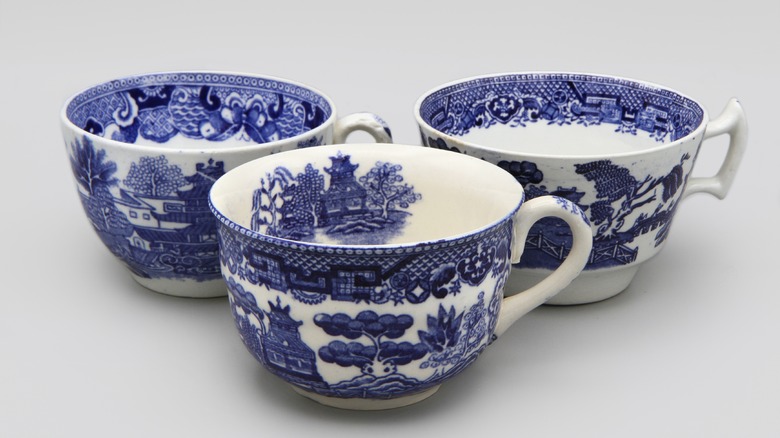
It's not uncommon for people to have a favorite mug. Sometimes, it's a run-of-the-mill mug with a funny quote. Other times, it's the mug's unique shape — perhaps it's curvaceous in a way that fits your hands perfectly. Then of course, there are handmade mugs, thrown on a pottery wheel before being glazed and fired. But whether your go-to mug is mass-produced or hand-thrown, it has a place in the long and fascinating history of ceramics. However, it's unlikely that its place is as significant as that of the Blue Willow pattern developed in the late-1700s.
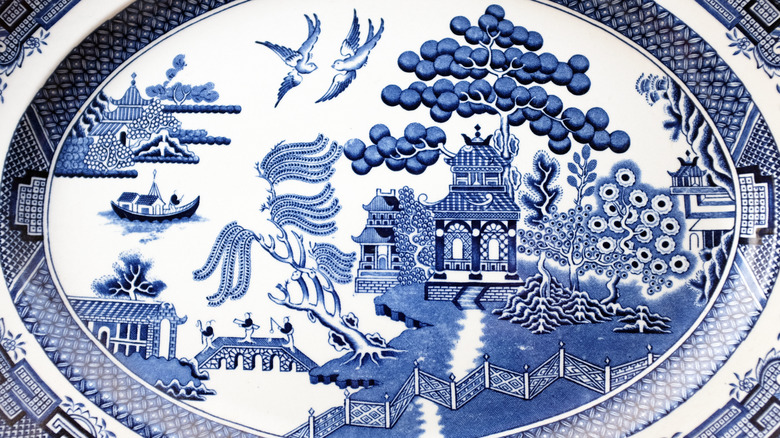
Blue Willow china typically has a white base with blue details depicting a Chinese-inspired scene. The details include willow and pine trees, a pagoda, a bridge with three human figures, a fence, boat, and two flying birds. Together, they tell the story of a young woman who fell in love with a man beneath her station. After a daring escape and pursuit by her angry father, the lovers are transformed into birds by sympathetic gods.
The Blue Willow pattern is iconic. And, because it was developed as "transferware," it was easy for ceramicists to print the pattern onto mugs, platters, bowls, etc., rather than painting them by hand. This helped keep prices down. In fact, by the 1930s, Blue Willow was common enough that it became the face of the "Blue Plate Special," a budget-friendly, filling meal for hungry diners.
The Blue Willow story
Interestingly, although the look and tale of the pattern are inspired by China, Blue Willow was originally produced in England. The European ceramics world had been shaken to the core when China began importing beautiful, bone-white porcelain in the 1600s. It took European makers roughly a century to figure out how to replicate this highly coveted porcelain, as they were limited to brown clay. (Although, in the meantime, they did figure out how to disguise their brown pottery with white glaze.) Nevertheless, there was a general fascination with Chinese porcelain and the blue-and-white color scheme common on Chinese porcelain at the time. All of this influenced the look of Blue Willow.
One of the reasons Blue Willow has endured in popularity over the centuries is just how accessible it is. While you can of course find pricier examples, plenty of it is available for around $10. And because it's been around for so long, you have your choice of antique, vintage, or newer pieces. Another perk is that the blue-and-white coloration makes sense in a variety of settings, from a thoughtfully planned dinner party tablescape to a more casual meal. If you want to start a Blue Willow collection, either because you're intrigued by the history or for daily use, consider storing it in a nice display cabinet to show it off. Then you, too, can introduce visitors to the history of the Blue Willow pattern.