

What Olive Garden Really Does With Its Leftovers
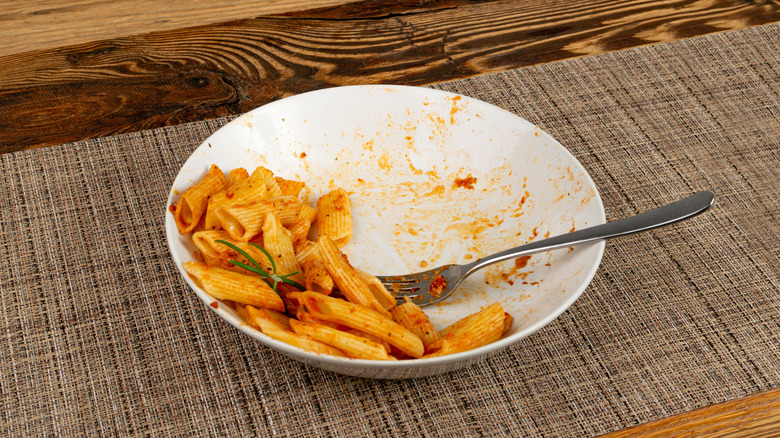
While no one claims Olive Garden is dishing out authentic or high quality Italian food, it's hard not to love its endless breadsticks and salad program alongside a lengthy lists of pasta options. And though we can put away some breadsticks, soup, and salad, some of these huge serving sizes lead to meals inevitably being tossed — or would be, if not for Olive Garden's attempts to curb waste at a corporate level.
The eatery's Harvest food donation program makes sure any extra food is repurposed. This would-be discarded food goes to feed community members via local nonprofit partner programs. Notably, every Olive Garden location participates in this 100% team member-driven initiative, and cumulatively have donated 41 million meals in the 20 years that the Harvest program has been in place. That's a whole lot of chicken Alfredo and eggplant Parmesan! Soups, sauces, pasta, and protein are rounded up from the kitchen — only unserved foods that have never been plated, of course — and are then frozen for preservation. Olive Garden's local partners pick this food up and put it straight to use in food kitchens and programs addressing local food insecurity.
Outside of Olive Garden's Harvest food donation program, the restaurant chain also has a partnership with Feeding America, the country's largest hunger-relief program. This has resulted in providing trucks to nearly three dozen food banks across 18 states. Additionally, Darden, the chain's parent company, has donated over $20 million to Feeding America through its foundation.
Olive Garden's efforts are a plus, but could be even better
Other chain restaurants could take note from Darden, the parent company presiding over Olive Garden, Yard House, The Capital Grille, Longhorn Steakhouse, and many other restaurants that participate in donating uneaten food. The food waste problem in the United States is one of staggering proportions (though you may be surprised that one country's waste numbers dwarf ours, four times over). While residential households are the biggest contributors of food waste nationally, restaurants and retailers alike also massively add to the overall food waste numbers.
The efforts of Olive Garden are certainly a win and a weight off the minds of conscious diners, knowing that the chain is doing its part in the sustainability fight. Even so, there's always room for improvement. Though much of Olive Garden's surplus food is donated, plenty more is still winding up in the landfill, no doubt. After all, no restaurant can repurpose uneaten food from diner's plate, of course — at least, not for human consumption. But there are options other than tossing those picked over pizza slices or uneaten ravioli into the landfill, where decomposing food attracts animals and hogs space of already overfilled landfills. This is where other restaurants and retailers commit to composting or turning half-eaten scraps into animal feed — like Aldi, which has taken a multi-faceted approach to repurposing food waste. While Olive Garden doesn't seem to have taken any initiatives to compost food scraps, its efforts are certainly a major step in the right direction.