

What To Consider Before Splurging For That Full Board Hotel Package. (It Could Mean Big Savings)
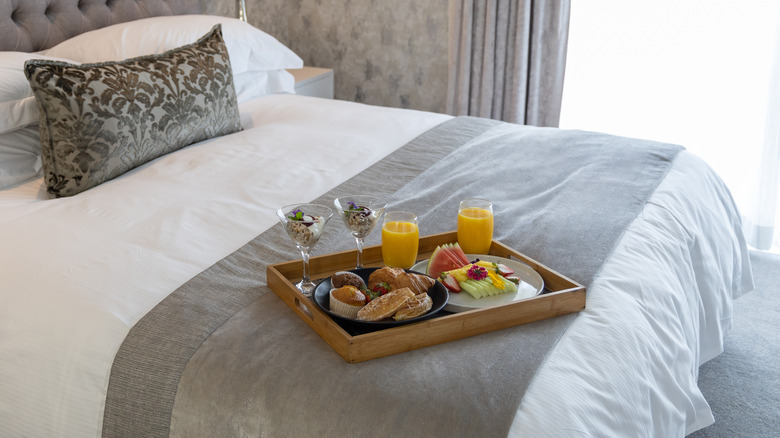
When you're booking a holiday (if you're anything like us), then planning how you're going to eat is sure to be at the top of your to-do list. When you're staying in a hotel, that often means a choice: Do you go for full board, half board, or none at all? Well, in order to answer that, you'll need to first understand what those terms actually mean. To find out more, we spoke to Victoria Fricke, the owner of luxury travel agency Vic's Vacations. "Full Board would be all three meals a day," she explained. "The exclusion being drinks. Some of course include tea, soda, juice, coffee, etc., but alcoholic drinks are typically excluded." So if you're after free booze, this won't get you it (at least, not most of the time.)
Half board, meanwhile, is what it sounds like — typically including breakfast and another meal, but not all three. "This depends on the resort whether it's lunch or dinner," Fricke added, so it's best to check before you book, if it's an important factor to you. "This is ideal for someone who wishes to explore or enhance dining by having flexibility in where they dine," she says, so if you're looking to eat out and explore the local food scene, but still want the dependability of hotel dining, the halfway house that half board offers is a good option. Alternatively, if you're going to be spending your time in a resort (or raiding the minibar), you might consider going all inclusive. As Fricke explained: "All inclusive is typically defined as all food, all snacks, and all types of drinks. (This still can vary at some resorts where more premium spirits are extra or reserved for certain room categories)."
When full board saves you money (and when it doesn't)

So, going for a full board option might sound like a great way to get some bang for your buck. But according to Victoria Fricke, there are a few things to take note of when booking to make sure that what you're getting really is a value proposition. "A lot depends on where you're going," Fricke explained. "If you're in Europe it would be a waste to have a full board experience, but when in Bora Bora for example you might want it." Continental breakfasts in Europe are seldom worth the money — especially when breakfast can look so different everywhere you go, so it's worth seeking out a local option. "When other options for dining are easily accessible, go use them, but if you're remote, full board is often times a better solution long term," Fricke added.
Another consideration is how much you're actually going to be eating. "As far as sizing goes, if you're more of a snacker v.s. full meals, a half board might be exactly what you need," she said. For the lighter eater, breakfast leftovers can be more than enough: "Save a croissant and apple from your large breakfast to eat later in the day tiding you over." At the end of the day, you've just got to weigh up the price to decide if it's worth it: "Ask yourself if in typical traveling situations do you tend to consume three full meals a day," Fricke said. "If you do, compare the pricing of paying out of pocket at the location you're going to v.s. a full board option."
How to decide when full board is worth it

So, once you've got an idea of when full board might be the most worthwhile option, it's time to apply that knowledge when booking your own holiday. Calculating whether it's the best value you can get is a complicated task — but while it can be daunting, Victoria Fricke had some tips to help you navigate the process. So, how do you get an idea of what you'll be spending? "Easy! Pull up the menu! Not all resorts will give you detailed pricing, but if you email the concierge you can typically get it," said Fricke. Consult fellow travellers for info, too: "Other great resources would be watching YouTube vlogs of people's experiences and seeing what a quick google search can pull. Many destinations or resorts have facebook groups and TripAdvisor pages you can ask within," she added.
When estimating the cost of a day's food and drink, follow Fricke's formula: "[T]hink of a heavy food day and a light food day where maybe you were off property doing an excursion or tour for a good chunk of the day," she said. "Then think of snacks and room service if you wanted a late night burger." Take an average of potential costs, factoring in both more expensive and cheaper choices, to get a good idea of your daily budget, and weigh that against the full board price of the hotel.
Considering all the impressive hotel bars in the United States, don't forget to think about drinks, too. As Fricke noted: "[Y]ou might not be more than a social once in a while drinker at home, but vacation tends to bring out the desire to do nothing but drink in some — account for the mind that kicks in after a couple glasses of wine..."