

The Odd Ruling Ohio's Supreme Court Made Regarding Boneless Chicken Wings
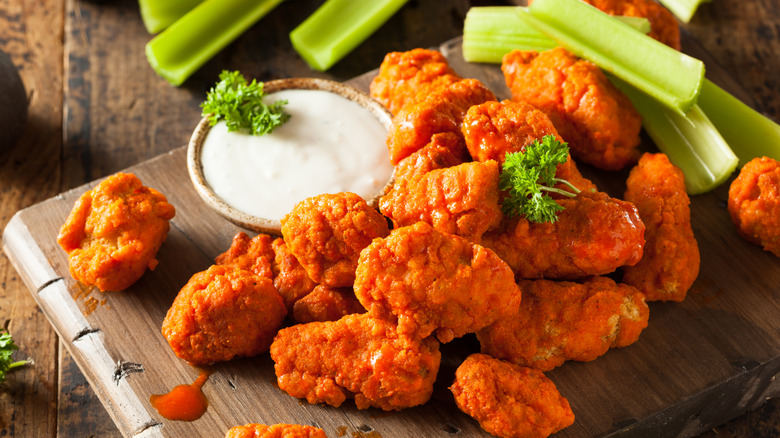
Maybe you're one of those people who loves chicken, but hates the sometimes-finicky process of chewing around the bones on a plate of spicy Buffalo wings. If so, you probably love boneless wings, which offer all the flavor with none of the work (never mind that they're actually made with chicken breast meat, not deboned wings). However, if you go to Ohio, you legally can't expect boneless wings to be perfectly boneless — and a court has even handed down a verdict stating as much.
It all stems from a fateful 2016 night, when Ohio man Michael Berkheimer ordered boneless wings at a restaurant in Hamilton, Ohio, and accidentally swallowed a nearly 1.5-inch piece of bone. It wedged in his esophagus, causing a bacterial infection and ongoing medical problems. Berkheimer sued the restaurant, its meat supplier, and the chicken farm for damages, arguing that they were negligent for selling a product labeled as "boneless" that contained a bone. Lower courts initially dismissed Berkheimer's lawsuit, and it eventually found its way to the State Supreme Court, which, by a 4-3 majority in 2024, threw out the man's claim to damages.
The reasoning for the decision came down to the idea that chickens have bones. As such, Berkheimer should've been watching out for them. However, this requires some unpacking to properly understand.
What boneless really means in Ohio

The decision hinged on the idea that "boneless" is a reference to a cooking style, not a promise that the food is completely bone-free. Some of the arguments to back this up are arguably a little strange, though. For example, the court's decision invoked the idea of chicken fingers, arguing that reasonable people don't expect that food item to actually contain fingers. (Never mind the fact that while chickens do have bones, they don't have fingers.)
However, the decision makes more sense once you consider how courts approach issues related to people getting injured by their food. Courts usually distinguish between "foreign" objects in food (say, a piece of glass) and natural objects — in this case, a bone. The restaurant or meat supplier might be found liable for damages if it was a foreign object, but because bones are inevitably part of chicken, the court decided that they're not responsible here — even if the menu promised "boneless" wings. Instead, it's the customer who should watch out for them. The court also found that because of the relatively large size of the bone, Michael Berkheimer could have "guarded against" his injury.
It's worth noting that nearly half the judges on the case disagreed, with the dissenting justices calling the reasoning "utter jabberwocky". They went with the straightforward argument that "boneless" means "no bones" (even pointing to dictionary definitions of this), suggesting it would be incoherent to tell the public that they should watch out for bones in "boneless" items. Yet, this simpler argument lost out by one vote, arguably earning this case a place in the pantheon of unusual fast food-related lawsuits.