

They're Clearly Purple, So Why Do We Call Them Red Onions?
We may receive a commission on purchases made from links.
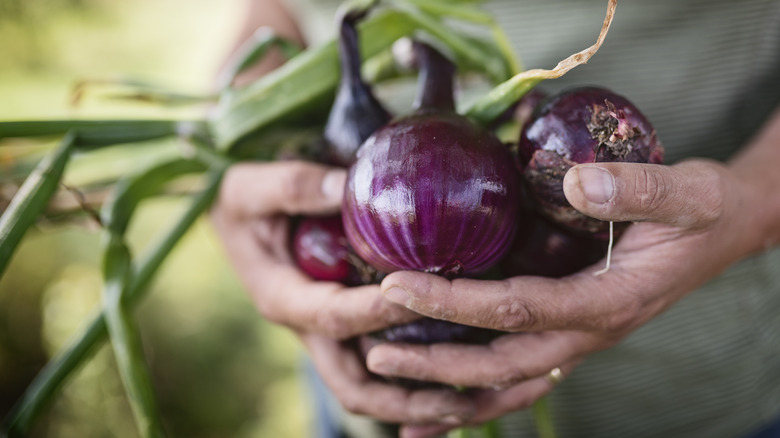
Not everything in the produce aisle is as it seems. In fact, some of these everyday foods are nothing like they are advertised. We are so accustomed to the names of products that we never stop to ask questions like, "Why is it called a pineapple in the first place?" After all, this fruit is neither an apple nor a product of a pine tree. And then there is the matter of red onions. Perhaps the most colorful member of the diverse family of onions, red onions are clearly purple. Why, then, are these purple alliums called red? While there is not one clear-cut answer to this question, some theories can point us towards the reasoning behind this seemingly inaccurate, but enduring, name.
The most prominent theory regarding red onions' name involves the often opaque world of linguistics or, rather, the study of how language has evolved. According to Paul Kay and Brent Berlin, authors of the 1969 book "Basic Color Terms: Their Universality and Evolution," the terms used for colors, across all cultures, have evolved in a predictable pattern. All languages began with just two concepts for color, black and white, and began evolving from there — starting with the invention of red. At this point, red would cover a much broader range of shades than it does today. At one point in time, red onions were likely seen as red by a culture bereft of any other word to differentiate them from this umbrella term.
When language meets color

Red onions got their name because, at the time of their discovery, purple didn't exist as a color descriptor. Over time, a more complex language for colors evolved, and hues like yellow, green, and, yes, purple, entered our vocabulary. As with many quirks of language, names don't always evolve with our understanding of the world. (For example, the pineapple was named by a British explorer bereft of any understanding of the fruit.)
It may seem strange to think that specific names for colors are a matter of invention. After all, red and purple being two distinct colors seems like a simple fact today. However, it is important to note that language plays a big role in creating these variations. Pink, in particular, was not used as a color descriptor in English until the 17th century. And before the word orange was invented, orange items were often called red or geoluhread in English-speaking countries, which translates to yellow-red.
Peeling back more theories
Now there is another, albeit less glamorous, theory that suggests red onions were named because of their use as a fabric dye. The color that the dye produced varied in color, but could create a hue close to red. So perhaps there are layers of meaning behind the (mis)naming of the red onion. Yet another possible reason for the "red" name might come from the fact that red onions do sometimes appear red while growing or when their outer skin hits the sunlight. These complex hues come from the presence of anthocyanins, which are compounds found in many fruits and vegetables.
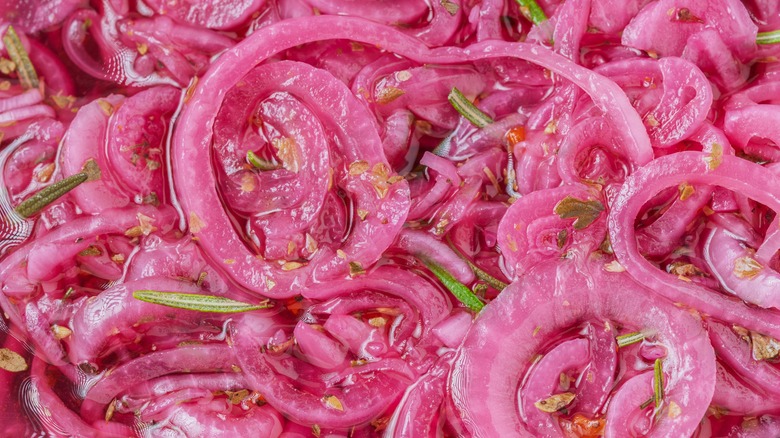
Anthocyanins are the compounds responsible for giving many fruits and veggies their red, purple, and even blue color. They are found in blueberries and even red raspberries , and are also the compounds that turn the tangy topping your nachos deserve, picked red onions, pink. This is due to a reaction anthocyanins have to acidic ingredients. So, yes, red onions are purple, but they can also be considered red (or when pinked, can even turn pink).