

Why A Chain's Michelin Star Doesn't Mean Excellence At Every Location
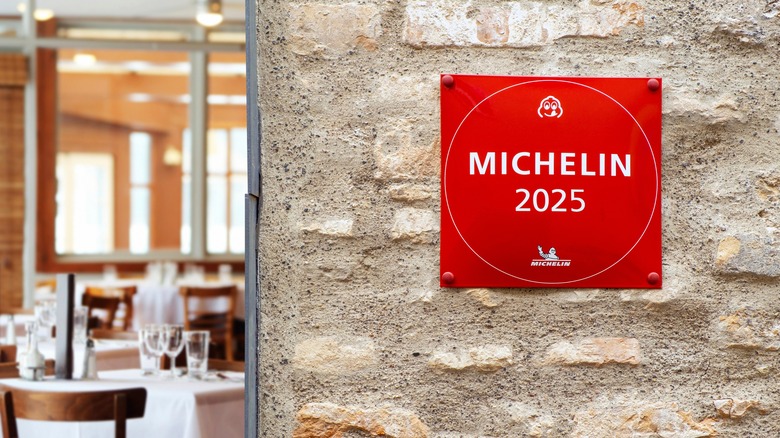
The Michelin star is, for many chefs, the pinnacle achievement in the culinary profession — and a dream that so many strive for but few achieve. The United States alone has only 263 Michelin-starred restaurants: 213 with one star, 34 with two stars, and a mere 16 with the coveted three-star ranking. Historically, there's been some confusion about what it takes to earn a Michelin star, how the process works, and whether it's awarded to the chef or the restaurant. And that's not even touching the biggest question: Why is a tire company ranking restaurants? That's a story for another day. One of the bigger questions is whether a chain can earn a Michelin star. The answer is technically yes, but the chain itself doesn't receive the star. Instead, it's awarded to the individual location.
Each chain location is evaluated on its own merit based on Michelin's five criteria: product quality, mastery of flavor and cooking techniques, the chef's personality reflected in each dish, harmony of flavors, and consistency. If a single location meets those standards to satisfy an inspector, it can receive a star. That doesn't mean another location in the chain automatically receives that same star.
So, in theory, a Burger King in Ames, Iowa, could earn a Michelin star. And, in fact, a Burger King in Belgium and a KFC in Australia have petitioned one, to no avail. In reality, no one is surprised that fast-food chains aren't winning over Michelin inspectors. That said, some small chains have seen a few of their locations awarded Michelin stars.
Michelin stars come, and Michelin stars go

The Michelin Guide makes it very clear that restaurants receive stars, not chefs. If a chef leaves, the restaurant retains its star or stars. "Sometimes the restaurant will promote the sous chef who is of equal talent to his or her predecessor; others might hire a talented chef from another restaurant," the guide says. "We will simply return to the restaurant and see how well we eat."
While chain restaurants ideally maintain the same standards from one location to the next, in practice, that isn't always the case. For example, Dinner by Heston Blumenthal in London has two Michelin stars, but the Dubai location has only one. Another example is Sushi Ginza Onodera, a high-end chain with 20 locations across the United States, Japan, and China that has earned a total of 15 Michelin stars. Two of its starred locations — New York and Los Angeles — have since closed.
Stars are difficult to achieve but easier to lose. That's why restaurants. not chefs, earn them. A chef can list stars on a résumé — Joël Robuchon accumulated 31 over the course of his career — but the restaurant must continue to earn the distinction. When a chef departs, it's up to the new chef to maintain the restaurant's star. This aligns with Michelin's philosophy that each chain location must earn its own star. If a chain manages to do that, good on them.