

What You Have To Look For To Choose The Perfect Store-Bought Pasta Every Time
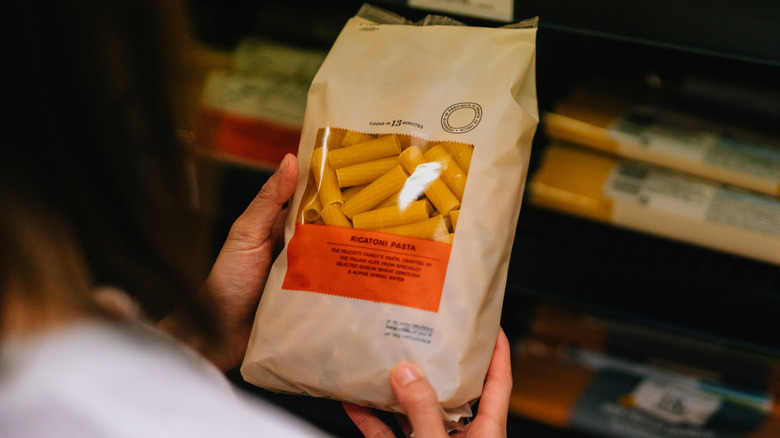
Using store-bought pasta shouldn't make you feel like you're taking a shortcut. In fact, the dried variety, which is what most people buy from the store, actually suits certain classic Italian pasta sauces better than fresh because of its more rigid structure, which makes for a firmer bite. However, if you've ever stood in front of the bewildering array of pasta on display at the supermarket, wondering which ones are actually good and which simply have great packaging, know that you're not alone. Fortunately, you don't have to wait until it's cooked to find out whether the store-bought pasta you finally picked is any good. There are easy ways to tell simply by looking at the pasta and its label.
Luca Corazzina, chef de cuisine at Olio e Più, which has branches in NYC, Chicago, and Washington D.C., spoke exclusively to Chowhound and dropped some simple tips on finding the perfect store-bought pasta every time. Brands are important, whether you're looking for the most authentic variety or for something more specific, like the best gluten-free pasta. "For dried pasta, I would stick to trusted brands like Barilla or De Cecco," Corazzina reveals. While most stores stock the dried variety, some places also have fresh pasta available. He advises, "When shopping for fresh pasta, I look for bright and even coloring. The texture should be slightly moist and supple." The chef recommends picking up fresh pasta from farmers' markets. Although some varieties of stuffed pasta, like ravioli, are available in many supermarkets, they won't be as fresh as what you'll find in a weekly local market.
The labels on store-bought pasta will tell you how the pasta is made
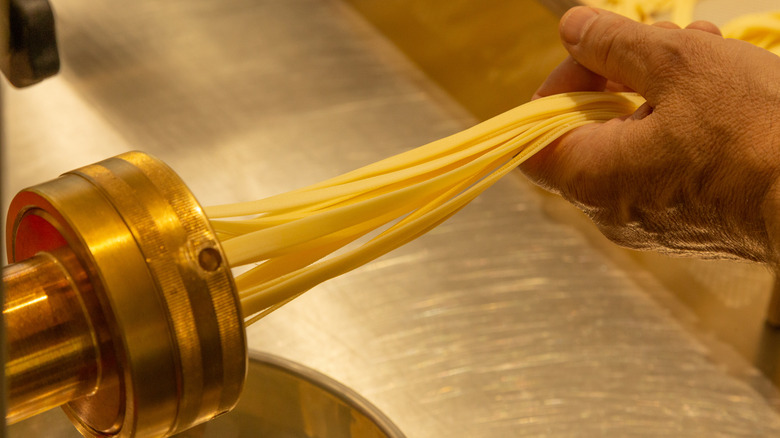
One of the most straightforward ways to pick up a quality pasta is to look for one that's bronze-cut or, in Italian, trafiliata al bronzo. Luca Corazzina explains, "This means the pasta was extruded through traditional bronze dies, giving it a slightly rough texture which helps the sauce cling better." How well your sauce adheres to the pasta is absolutely crucial, because a flavorful pasta sauce is wasted if most of it remains at the bottom of the dish while you eat bland noodles.
The mention of bronze-cut on a label can also tell you that the overall process used to make pasta is high quality and that the company isn't cutting corners. Traditional uncoated bronze dies are more difficult to maintain, and therefore, the cost of making pasta with them is generally higher. A pasta-making company looking to cut costs will likely use dies that are not pure bronze or have some form of coating. Thus, a smooth pasta (that's not bronze-cut) could be a sign that other aspects of the pasta are also compromised to cut costs.
Next, check what the pasta is made of, as it is the ingredients that differentiate pasta from other varieties of noodles. Corazzina advises picking up pasta made from semolina or durum wheat, as this type of flour is what gives pasta its characteristic al dente bite. Ultimately, the chef explains, this is what gives the pasta structure and flavor.