

Why A Sous Vide Is Your Grill's Best Friend
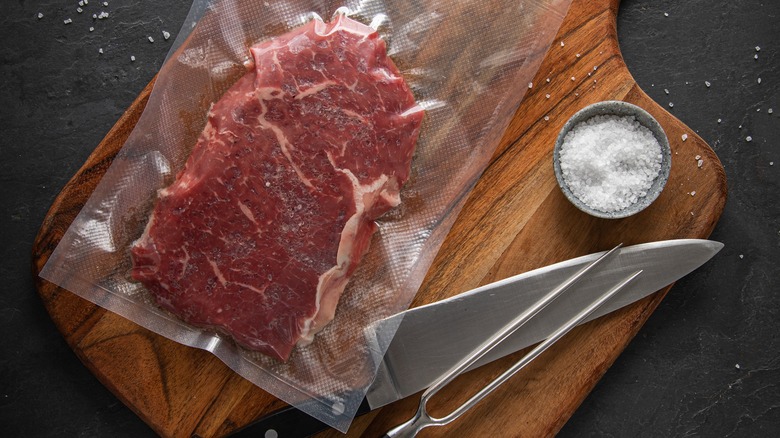
Grilling and barbecuing are among the most enjoyable ways to cook, especially when entertaining a large crowd on a beautiful day. But there are some common pitfalls (pun intended) that come with the territory, such as the difficulty of nailing your meat's internal temperature. Additionally, there are also days when cooking outside over a hot flame for long periods of time is tough — in sweltering summer heat or freezing winter cold, for instance. These challenges don't mean you have to forgo the grill entirely, however. They just mean it's time to employ a secret weapon: sous vide.
Sous vide is a cooking method that works by submerging hermetically sealed food into a temperature-controlled water bath, slowly heating it to the exact desired temperature without sacrificing moisture. It's commonly done with steak and other delicate foods, but when used in tandem with grilling, it's a game changer for all types of proteins. Chowhound spoke exclusively with Scott Thomas, owner of Grillin' Fools, about how these cooking styles can compliment each other.
"It is a fantastic way to really load proteins with lots of flavor, and it helps ensure things are perfectly cooked every time," he said. "Cooking outside over live fire has a lot of wild variables that are hard to control ... The sous vide method reduces the impact of these variables by a lot, because it very precisely brings that protein to just the edge of being done, and then it's finished on the grill."
Follow these tips to maximize sous vide and grilling success
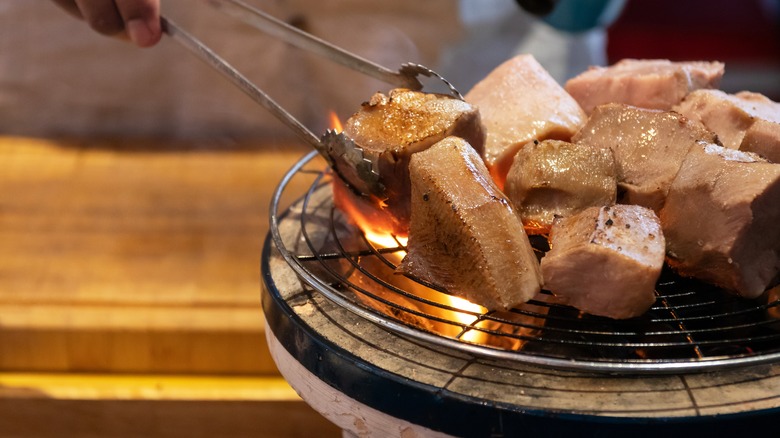
Scott Thomas has a simple routine for the sous vide and grilling combination. First, load your vacuum-packed bags of meat with aromatics to infuse flavor. Then, use the sous vide to cook to about 10 to 15 degrees Fahrenheit below the desired internal temperature, and finish on a "wicked hot" grill. "This browns the meat and caramelizes the proteins, making the dish extra tasty, all the while bringing [it] up to the final desired doneness," he told Chowhound.
According to Thomas, the best cuts of meat for this method are those typically cooked hot and fast, such as steak, pork chops, and fish, rather than larger roasts like pork shoulder or brisket. "Once a roast hits an internal temp of around 140 degrees Fahrenheit, the meat won't take on any more smoke flavor," he explained. "If they are brought up most of the way with the sous vide method, then there won't be any smoke flavor in the meat and the bark will be garbage." But a cut like ribs can benefit from the low-and-slow sous vide method topped off with crust from the grill.
To make this one of your go-to grilling hacks, keep your flavors simple, practice patience, and don't be put off by barbecue purists. "Some folks will complain ... That it's not as romantic or rustic as slapping down the meat and cooking over a live fire the whole time," Thomas said. "I'd rather have a fantastic final product than hold onto some perceived badge of honor."