

Here's Every Ingredient In McDonald's Sausage Burrito Eggs
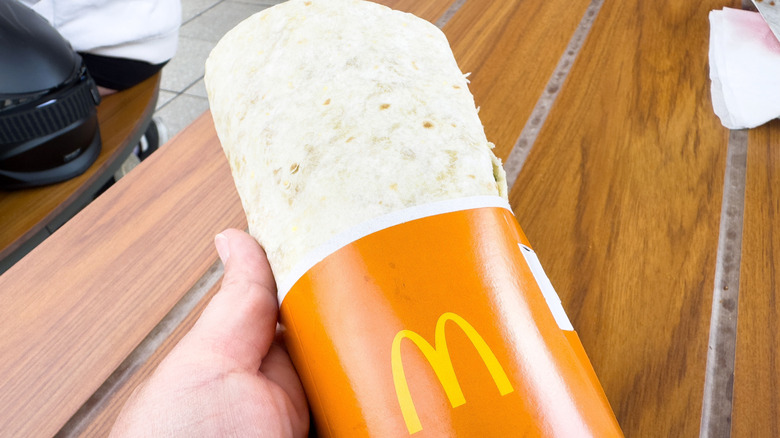
When McDonald's first opened its doors as a barbecue joint in 1940, breakfast wasn't even a thought. Fast-forward 30 years later to 1970, when several Pittsburgh-area locations started selling donuts and other pastries in the morning — the beginning of the chain's breakfast branch. These days, every McDonald's serves a variety of breakfast sandwiches, burritos, and other items, but if you're one to enjoy the sausage burrito specifically, you might want to know what's in those eggs.
McDonald's sausage burrito is a flour tortilla filled with a slice of processed American cheese and a sausage and egg mixture. Those are the two main proteins within the breakfast item, but the mixture includes a variety of vegetables, too: tomatoes, green chilies, and onions. Salt, spices, and other natural flavors are added to build flavor, as well as sugar and rosemary extract. Milk and soybean oil help enhance the sausage and egg mixture's texture. But in addition to those better-known ingredients, there are a few things you might not be familiar with — and they all play a role.
The lesser-known ingredients in a McDonald's sausage burrito's eggs

Within those sausage burrito eggs are a few more additions that you might not anticipate: modified corn starch, xanthan gum, dextrose, citric acid, and calcium chloride. Modified corn starch acts as a stabilizer and thickener, likely helping to create the egg mixture's overall texture and mouthfeel. Xanthan gum has a similar purpose; it can be used as a thickener and stabilizer, and as an emulsifier when needed, too. Xanthan gum is often how restaurants thicken their sauces.
Dextrose is a type of sugar that's similar to glucose and is usually used to artificially sweeten a dish. Citric acid is listed twice in the eggs' ingredients list, and that could be because two kinds are used: the naturally occurring acid in citrus fruits, which helps add flavor, as well as a synthetic version, which is used as a preservative. The latter version is made from a type of mold called Aspergillus niger. Finally, calcium chloride is a form of salt, which acts as a preservative to help food last longer. While all these extra ingredients may seem confusing, they're actually pretty common in purchased food items.