

Should You Ever Rinse Salmon Before Cooking?
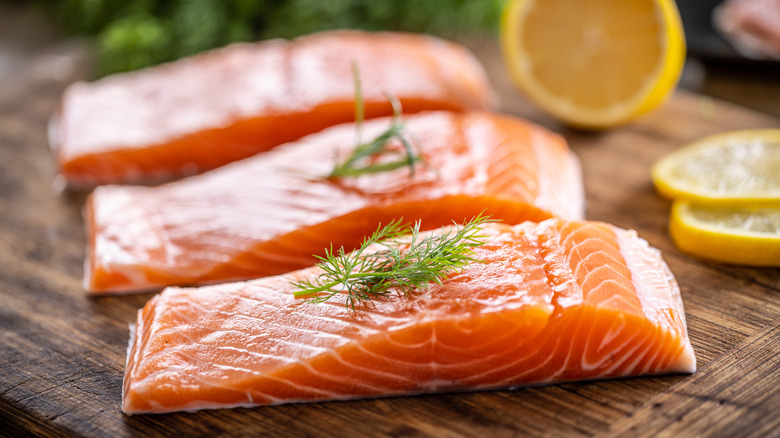
When it comes to salmon, you've got plenty of choices. Do you prefer sockeye or Atlantic? Wild-caught or farm-raised? Marinated or simply seasoned? One of the salmon preparation questions you don't need to worry about is whether you're supposed to rinse your salmon before cooking. Chowhound talked to Campbell Mitchell, the founder of Quest4Food, a consulting company focused on quality, food safety, and sustainability, to get the details on the safest way to prep salmon before it hits the grill, stovetop, or oven.
The answer is simple: Mitchell gives a hard pass to rinsing salmon before cooking. He explains, "The USDA and food safety authorities advise against rinsing raw meats or fish, including salmon, because it can spread bacteria through water droplets onto surrounding surfaces — commonly referred to as 'aerosolized contamination.'" Mitchell goes on to say that cooking salmon to 145 degrees Fahrenheit (or 63 degrees Celsius) is the only way to actually eliminate potentially harmful bacteria from your fish.
Some professional chefs do rinse salmon in their kitchens, Mitchell says, adding, "However, for home cooks, the risk of cross-contamination far outweighs any perceived benefit. Instead, pat the fish dry with paper towels if needed." If rinsing salmon and other meats before cooking is a non-negotiable for you, as it is for some communities, it's key to be super-careful. "Use a slow stream of cold water in a clean sink," Mitchell advises, "minimize splashing, and sanitize the sink and surrounding area thoroughly afterward with a food-safe disinfectant. This includes countertops, taps, and any utensils nearby."
Preparing salmon safely: home kitchen tips
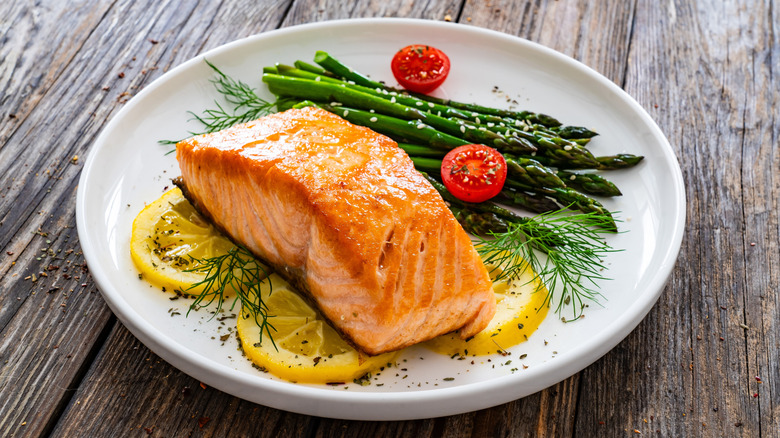
After you've chosen the best cut of salmon at the grocery store and you're ready to get cooking, it's essential, Campbell Mitchell says, that you prep your fish effectively, even though you aren't going to be rinsing it. He recommends checking the quality of the fish first by smelling the surface. Your salmon shouldn't smell fishy — it's okay if it smells slightly briny. Then, take a look at it. "The flesh should be firm, moist (not slimy), and vibrant in color," Mitchell explains. "Use clean paper towels to pat it dry, which helps with browning and flavor during cooking."
Next, you'll want to trim away the dark muscle on the salmon's skin side, if you prefer not to eat this part of the fish. Then, divide your salmon into portions. Carefully wash your hands after trimming and portioning salmon, and be sure to place your prepared fillets back in the refrigerator (perhaps in a seriously flavorful three-ingredient marinade) until you're ready to start cooking. "Never leave it at room temperature for more than two hours," recommends Mitchell.