

Can You Substitute Milk For Heavy Cream When Making Chocolate Ganache?
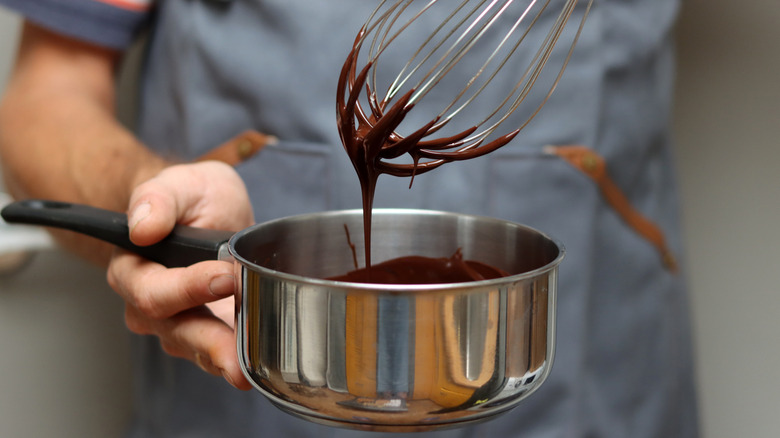
Whether it's destined to become homemade truffles, cake frosting, a layer in a decadent tart, or something else, ganache is a deliciously indulgent, versatile ingredient. And it can be made using just two ingredients: a good kind of melting chocolate and heavy cream. But let's say you're feeling the need for something rich and chocolatey, stat — but have no heavy cream on hand! Can you use milk instead? They're both dairy products, after all.
Unfortunately, Alysha Dintale, executive pastry chef at The Goddess and Grocer, tells Chowhound that "Substituting milk for cream in ganache usually doesn't work well." This is due to the higher fat content in the cream, "which is essential for creating a smooth, stable emulsion with the melted chocolate." Substituting milk can result in a disappointingly thin or possibly grainy ganache rather than the thick, shiny, and velvety texture it's known for. However, you can find ganache recipes that use both milk and butter, with the latter boosting the fat content (some people even recommend using butter to give a cream-based chocolate ganache an extra-glossy finish).
A better substitute than milk, says Dintale, is coconut cream, which also happens to be vegan. "It has a rich, creamy texture and a fat content that closely mimics heavy cream," she says. Plus, the additional flavor doesn't hurt — if you like coconut. "Just be sure to use full fat coconut cream and not coconut milk or light versions, as those won't provide the necessary richness or structure," Dintale cautions.
General guidelines for dairy substitutions

Home bakers can apply some general principles when it comes to dairy substitutions. "When substituting dairy," says Alysha Dintale, "you want to match three main components: fat content, acidity, and texture." As mentioned earlier, substituting lower-fat milk for cream can lead to a thin ganache with a less-than-smooth texture. In terms of acidity, Dintale explains, "Swapping a neutral dairy (like whole milk) with an acidic one (like buttermilk) can alter both the taste and the rise of baked goods if the leavening agents aren't adjusted accordingly." Of course, sometimes there are creative work-arounds. For example, you can always make your own buttermilk using whole milk and either lemon juice or vinegar.
Failing to take these three components into account most commonly lead to issues like "curdling, dense, or gummy textures, poor rise, or mixtures that break or separate," the pastry chef warns. Thankfully, there are a few ways to troubleshoot ganache that's already turning out poorly. If it's separated and grainy, try stirring in some hot water until it comes back together. Or, if it's on the thin side, try adding some more chocolate or simply letting it cool in the refrigerator.
The bottom line, according to Dintale, is that "substitutions can work well, but they require understanding how each ingredient functions within a recipe." When it comes to ganache, this means sticking to something with a high fat content for best results.