

These 2 Mason Jar Brands Are Actually Owned By The Same Company
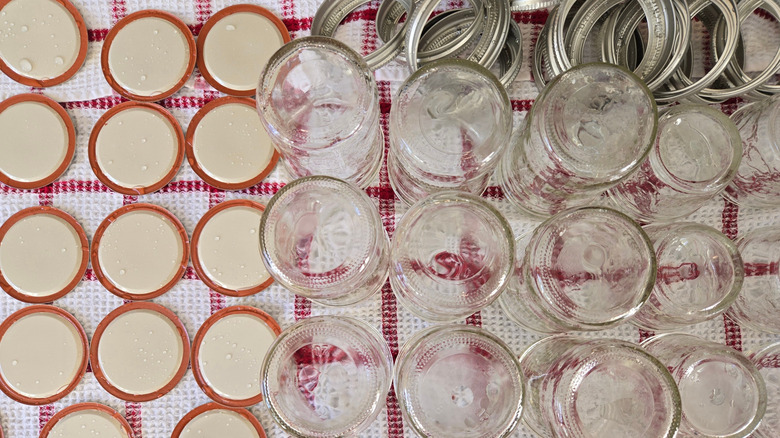
The origin of Mason jars can be traced much farther back than you'd imagine. Indeed, their history begins well before how-to recipes for cakes-in-a-jar, cutesy Mason containers in place of soap dispensers, and layered Mason Jar salads. Despite the different branded names across your canning materials, Ball and Kerr are actually owned by the same company: Newell Brands. But how this consumer goods company came to own them is an interesting bit of Mason jar history.
The invention of Mason jars was kicked off in 1806 by Frenchman Nicolas François Appert, who won a cash prize offered by Napoleon Bonaparte to anyone who could devise a better way to preserve food than the typical drying, fermenting, and salting of earlier human history. Appert's method depended on the fact that food could be preserved for extended periods if heated and then cooled, creating a seal. The invention of the Mason jar by John Landis Mason followed in 1858, sending the food preserves industry into a new direction. What Mason had invented was a unique glass jar-making machine. His design entailed a market-sweeping sealing fixture that allowed its lid to fasten onto the rim in a downward spinning motion — simplifying and increasing safety of canning food. Once Mason's design went public, many other brands joined the market, including Ball and Kerr.
The Kerr company, established in 1904, produced an updated, wider-mouthed, and "self-sealing" style of canning jar. The company was sold to Ball in 1992. As the competition settled and the Mason craze plateaued, Newell Brands began attaining various canning jar companies, including Ball and Kerr, adding them to its lineup of other household names like Rubbermaid, Mr. Coffee, and Yankee Candle.
Not all jars are safe for canning
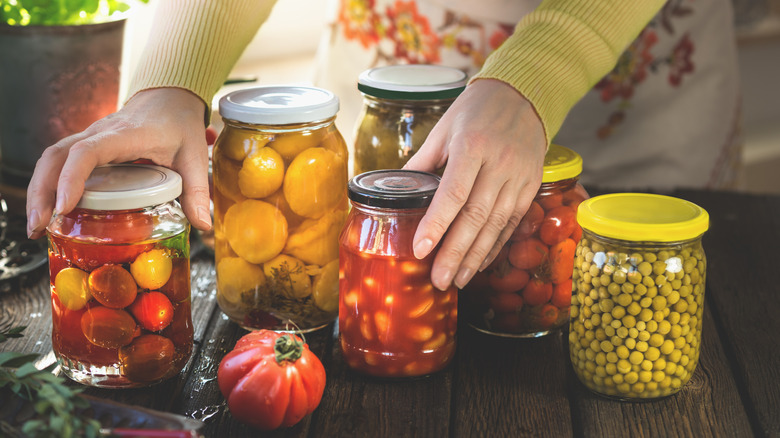
Preserving jars are produced by a wide number of brands, now in a variety of different styles. Often used for the short-term storage of foods like jams and pre-cooked meals, they are also great for longer-duration recipes. But when it comes to the canning process, not all jars are fit for the purpose. You'll want to ensure the containers you end up using are specifically designed for canning and are able to withstand intense pressure and heat. The good thing is, both Ball and Kerr products are deemed safe to use — their components are also swappable, working equally well across brands.
However, it's important to know that the standard for canning has changed — deeming older canning jars from your grandparents' era unreliable (think metal closures, zinc caps, and glass lids). Therefore canners are advised against using antique jars as they pose health and safety risks and are prone to seal leaks and breakage. Your best bet would be relegating them to solely decorative purposes. This is because canning jars only last about 10 years before their durability weakens. Though it may seem a sustainable option to use recycled containers you have around the house, like jam or honey jars, they're unfortunately deemed unsuitable as well.
With the variation of Mason lookalikes out there, it's important to ensure you use the correct products for canning. If you are uncertain, the packaging will usually note its distinct approved uses. When canning, it's important to make sure you're replacing the lids each time. It may very well be a Newell Brands product you opt for as Ball and Kerr are tried and tested classics, however, you still need to make sure it's properly cleaned before canning and sealed when stored.