

This Is How Much Taste You Lose While Eating On A Plane, According To Science
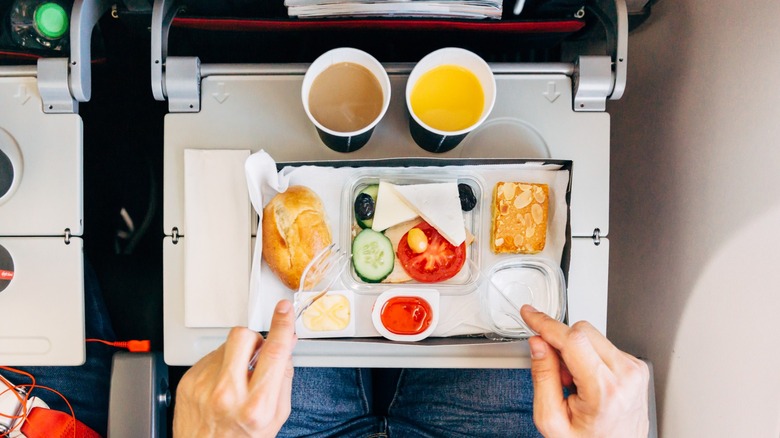
As comedian Jerry Seinfeld once said, "What's the deal with airplane food?" Everyone knows that airplane food isn't generally good, but there is so much more going on that alters our experience when dining on an airplane. After all, when you're thousands of miles above the ground, the human body undergoes changes. A 2010 study funded by Lufthansa and conducted by German researchers at the Fraunhofer Institute for Building Physics found that we lose around 30% of our sensitivity to sweet and salty flavors in airplanes.
The researchers found that the lower air pressure, combined with low humidity and other physiological stimuli unique to airplanes, dilutes our taste buds. Approximately 80% of our sense of taste is influenced by our sense of smell. Moreover, moisture is needed for our sense of smell to function. At higher altitudes in a pressurized cabin, the humidity levels drop, impairing our olfactory system. This affects our taste buds as well.
Ultimately, the sensory changes lead to food tasting quite bland, contributing to airline food's poor reputation. Airlines intentionally over-season their food to compensate for that, an American Airlines representative told the BBC, but there are other tricks of the trade that the airlines' cooks implement to try to improve the in-flight dining experience.
How airline chefs compensate for the loss of smell and taste
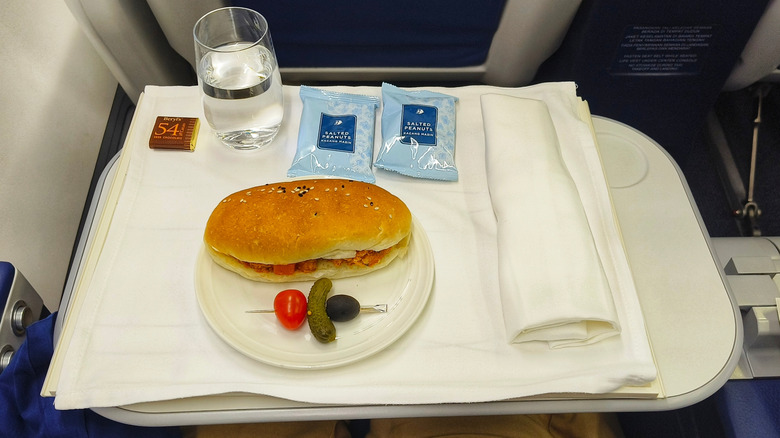
To compensate for your dulled taste buds, airlines take a strategic approach when creating their menus as well as how they prepare your in-flight food. Since sweet and salty flavors are weakened in the air, the chefs will turn up the intensity. In other words, the chefs will add more seasoning along with a heavier use of umami-rich ingredients like tomatoes and mushrooms. Although the obvious solution might sound like adding more salt and sugar, that's simply not the case. In general, airlines collaborate with culinary experts who conduct taste tests in simulated cabin environments to better understand how flavors react at altitude.
Texture also plays a major role. After all, crisp and creamy foods can add another dynamic to your dining experience. Crisp foods are known to bring out salty flavors, while creamy foods do the same for sweet flavors. In terms of beverages, some wines and sparkling drinks are chosen specifically because they retain their balance better in drier air. Alternatively, tomato juice is typically on the menu since the altitude makes it taste better.
Although your senses might be dulled from the altitude, airlines are doing what they can to provide a pleasant experience. If you're struggling to find something to eat, luckily, there are many in-flight food and beverage hacks available.