

The Cooking Tool You'll Always Find On Martha Stewart's Kitchen Counter
We may receive a commission on purchases made from links.
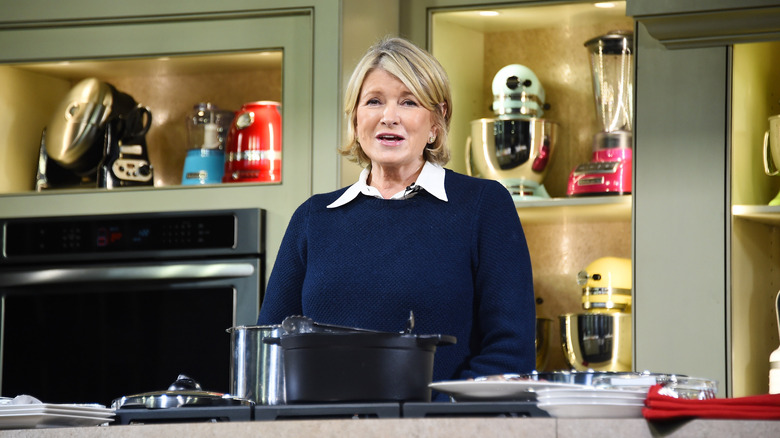
Martha Stewart may be the queen of the organized kitchen, but there's one item she leaves sitting out in the open. Stewart's cutting board stays on the counter so it's always in reach and ready for any food prep. This strategy is also a smart way to ensure there's always a spot to put down a hot pot without risking damage to countertops. This is especially important if you have marble countertops, which can easily stain or scratch. And though marble, granite, and quartz all have some level of heat resistance, it's best for the life of your countertop to use a cutting board so as not to risk any staining, cracking, or chipping.
With all the types of cutting boards, what is best? Stewart prefers to use a commercial cutting board, which is typically made of high density polyethylene, a durable plastic. The Martha Stewart BPA Free Plastic Cutting Board is one such option and is both gentle on knives and dishwasher safe. However, wood cutting boards may look a little nicer, which is something to keep in mind when you're going to be leaving your board out all the time. The Martha Stewart Lochner 18 x 12-Inch Beech Wood Cutting Board w/Juice Groove Steward is also gentle on stainless steel knives, but is hand wash only. Just know that wood boards have their limitations and can stain, as well as hold odors and moisture. They require a bit more care.
How to care for your cutting board
If you want to follow Martha Stewart's lead and keep your cutting board out on the counter, you'll want to make sure it stays in good shape. First, don't make a cutting board mistake that causes huge food safety hazards. The USDA suggests designating one cutting board for produce and bread, and a separate one for raw meat, poultry, and seafood. This can help avoid cross-contamination.
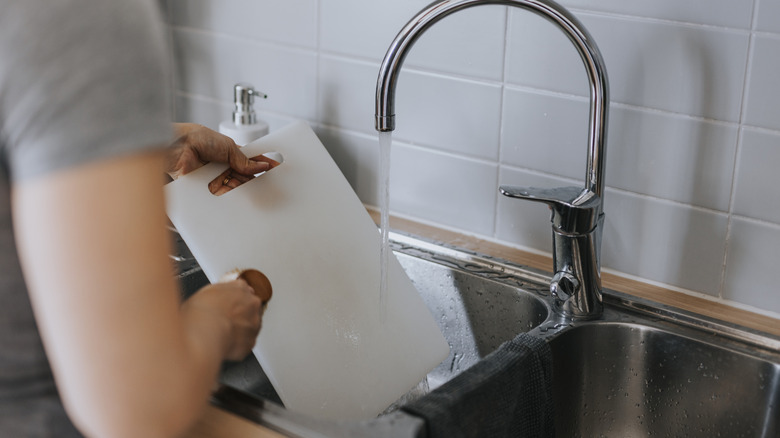
To properly sanitize and clean any type of cutting board, wash it with hot, soapy water, then pat dry. Solid wood boards can be put in the dishwasher unless directions state otherwise, but make sure it is not laminated, as that can cause the board to split or crack. Boards can also be sanitized by with a solution of one tablespoon of unscented liquid chlorine bleach per gallon of water. One crucial step that prevents your wooden cutting board from drying out is to coat and buff it with food-safe mineral oil and beeswax, or use a premade mix like Clark's Cutting Board Oil every few weeks. Once your cutting board looks worn or develops grooves that are hard to clean, it's time to toss it and look for a new one.