

This US State Produces The Most Turkeys, And They Outnumber People 7 To 1
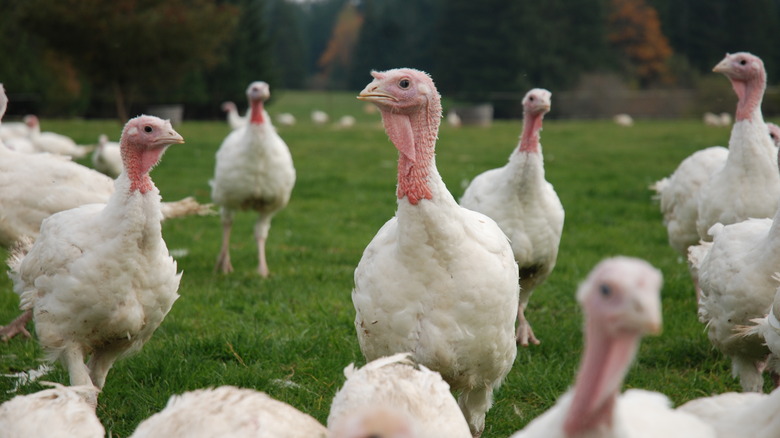
Turkey is the crown jewel at most Thanksgiving dinners, and for good reason, as it is a uniquely American bird. Outside of its holiday presence, however, turkey can be found in various forms, from deli meat to sausages. It may be less popular than chicken, but it holds its own in sandwiches, on breakfast plates, and within any number of dishes. In recent years, turkey has become increasingly popular, thanks to its low fat content and rather mild and adaptable flavor profile. Despite recent outbreaks of avian influenza, which have reduced turkey production significantly, the United States stands as the most prominent source of the bird in the world. And there is one state in particular that produces far more turkeys than any other state.
Minnesota, known as the land of 10,000 lakes, is also home to quite a few turkeys, as it turns out. In fact, in 2021, the state produced 40.5 million turkeys as compared to the state's human population, which sat at about 5.7 million, meaning that the fowl outnumbered human Minnesotans by about seven to one. And though the state's farmed turkey population has depleted some in recent years due to the avian flu, it produced about 33.5 million turkeys in 2024; the state still tops all others in turkey production. This reigning turkey supremacy is not a happy accident, but the product of generations of development of the turkey farming industry, proximity to useful agricultural products, and some serious campaigning by the state's turkey producers.
A history of Minnesota turkeys
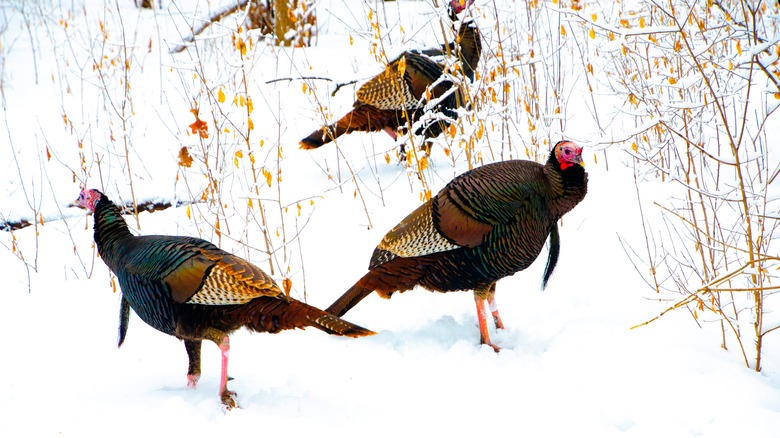
Turkeys are no stranger to the soil of Minnesota. Like many states, Minnesota has an indigenous turkey population. However, over the centuries, due to urbanization and over-hunting, the native turkey population was worn down to nearly nothing by the 20th century. That was, until the 1970s, when wild turkeys were re-released into the state. However, while wild turkeys struggled to flourish in the state during the early 20th century, their domestic counterparts thrived. During the early 20th century, through the 1920s and 1930s, much of Minnesota's turkey farming took place on small, often family-run farms. These farms were often beset by disease and cold snaps, which caused turkeys to die off at high rates. However, in the 1930s, a state-run campaign was started to reduce disease in poultry. And in the 1950s, after several natural disasters, turkey farmers began moving their flock indoors to spare them from the cold. These practices helped to boost the number of birds within the state.
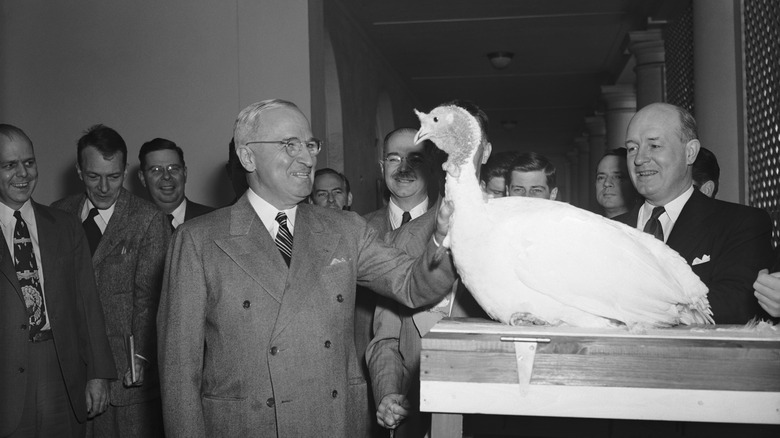
Of course, Minnesota's turkey touch didn't stop with modernized farming methods. Minnesota was actually quite instrumental in one big turkey practice: the presidential turkey pardoning. In the 1940s, Graydon McCulley, a Minnesota native, became president of the National Turkey Federation, and, as a part of his role, flew in a Minnesota turkey to present to President Truman for Thanksgiving. This presentation was a prelude to John F. Kennedy's 1963 turkey pardoning, which later led to a more official Thanksgiving turkey pardoning practice instated by George H.W. Bush. Now an annual tradition, Minnesota turkeys are still commonly chosen for the holiday "pardoning".
Why Minnesota makes for great fowl
There are many states in the U.S. that produce large amounts of turkey, so what makes Minnesota a cut above the rest? The state's fowl supremacy comes down to a few factors. For starters, Minnesota is home to several large poultry companies, including Jennie-O, a massive turkey producer, now owned by Hormel. The state is also home to many turkey farmers who count the business as a family tradition, often working turkey farms through several generations. Thanks to this familiarity, these farmers are more likely to have an intense and studied knowledge of the ins and outs (and ups and downs) of the industry. Simply put: They know what they're doing.
Minnesota also doesn't limit its turkey products to the domestic market. In fact, the state exports about 13% of its turkeys to other countries. It also helps that Minnesota is a large producer of products such as soybeans, corn, and other grains, which comprise the diet of farmed turkeys. Minnesota is also quite close to other soy and corn-producing states, such as Iowa, which grows the most corn in the United States. It isn't just the farmed turkeys that are flourishing, however. In recent years, the state's wild turkeys have increased in numbers and have even become a common sight in the streets of Minneapolis and St. Paul. So it seems that Minnesota certainly has quite a bit to squawk about.