

The Government's Been Lying To You About Rhubarb
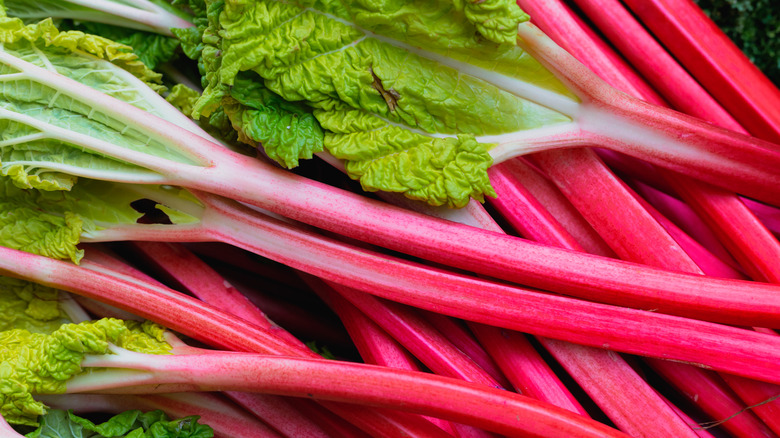
Rhubarb, mystery that you are. Often grown in the shadows (or under a tarp), these tart red shoots occupy a peculiar place in the cornucopia of produce. It is related to buckwheat, but one of the best ways to cook rhubarb is to use it in desserts, paired alongside the bright, strawberry, a fellow spring crop. You simply haven't lived if you haven't had a slice of strawberry and rhubarb pie, served with a cool scoop of vanilla ice cream (or, a strawberry rhubarb cocktail if you prefer your desserts to be drinkable).
For this reason, you might be inclined to label the rhubarb as a fruit. And you wouldn't be wrong to do so, legally speaking (at least in the United States). Yes, legally, rhubarb is a fruit. However, scientifically speaking, it is a vegetable, as it comes from a part of the actual plant (root, stem, or leaf), rather than the flower portion. It also, unlike other fruits, does not contain any seeds (but like many vegetables, rhubarb makes a great addition to a savory salsa). So, simply put, it is both. It just depends on whether you are asking a scientist or a lawyer. But herein lies the question — why would the U.S. government lie about what a rhubarb is? Well, like many things in our government, it all comes down to taxes.
The legality of the produce aisle
Officially, rhubarb took on its fruity status in 1947. The United States Department of Agriculture reclassified rhubarb because tariffs applied to vegetables were higher than those on fruits. This decision was based on a New York State court case, in which it was argued that because rhubarb was often served as a dessert, and was rarely, if ever, served as a part of a savory dish, that it was more akin to fruits than veggies, practically speaking. This argument seems to have stuck, because rhubarb is still legally a fruit in the United States.
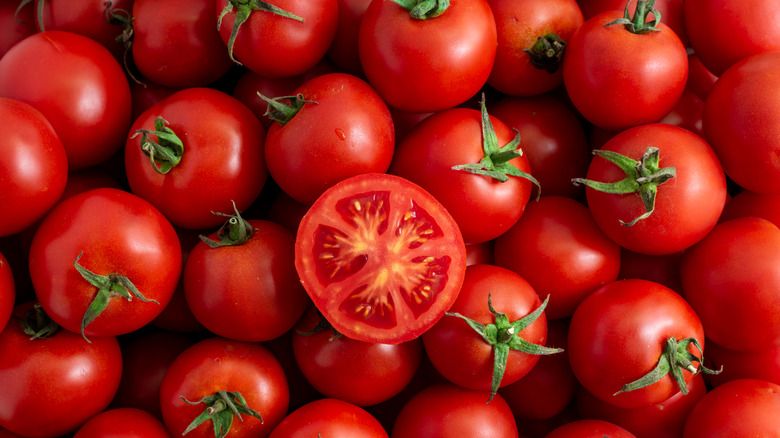
Not to worry, though, as the rhubarb isn't the only piece of produce with legal status that is at odds with its scientific categorization. Tomatoes, which are scientifically classified as fruits, are legally classified as vegetables in the United States. The reasoning? Once again, it comes down to taxes. In an 1893 Supreme Court case, tomatoes' fruit status was put to the test. This challenge came about after a tariff on vegetables was put into place in 1887. Notably, this tariff did not apply to fruits. This caused quite a bit of confusion regarding the tomato, which is often consumed as a vegetable would be (in savory dishes), but is a fruit due to its seeds and the fact that it comes from the flower portion of the plant. Ultimately, it was deemed a vegetable, legally at least.