

Wait, Did Vodka Exist In Medieval Times?

Have you ever wondered where some of your favorite spirits originated? It may come as a surprise that some have legacies strong enough to appear in Sumerian hymns dedicated to the goddess of beer. Vodka, too, is a legendary spirit in its own right. It is not only the world's most popular spirit, but can also be traced back to the Middle Ages. Of course, like much of culinary history, its origins are debated, with both Russia and Poland claiming to be the birthplace. What's certain is that, while it may not have exactly been the vodka we know today, it was there.
Russia and Poland both claim credit for vodka's creation, each offering their own proof. New discoveries can shift the timeline, but as of now, the first record of a vodka distillery dates to 1174 in Khylnovsk, Russia, about 500 years before the end of the Russian Middle Ages. In Poland, the first recorded recipe of vodka, then called "wodka," doesn't come around until 1405, in a document called the Akta Grodzkie, which translates to "town records". While this would suggest Russian precedence, vodka wasn't always referred to by its modern name in either country. In Russia, a similar spirit was known as "varenoe vino" as early as 1399; in Poland, it was originally called "gorzałka," which can be traced back to the 11th century.
Vodka was originally applied for medicinal use in medieval times
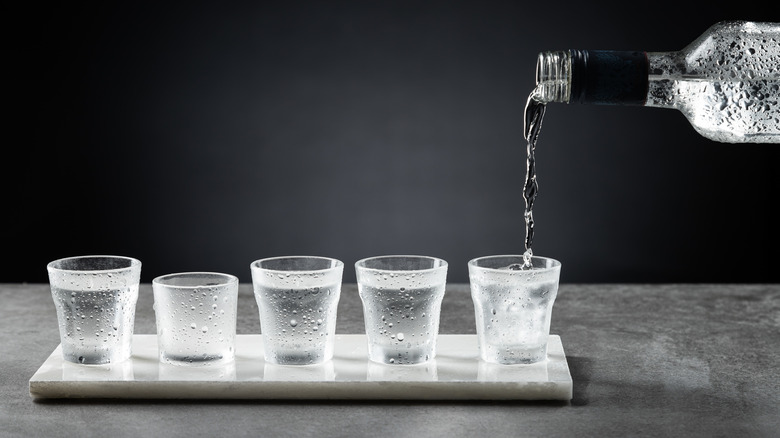
Moving on from the debate over vodka's origins, the spirit's early use and appearance were much different from what we know today. As the distillery methods were certainly more primitive by modern standards, vodka was less potent at only about 14% ABV and not nearly as smooth as it is currently — earning the name "gorzałka" which is often translated as "burning water." In fairness, it wasn't about the flavor or how smooth the spirit was, as it served medicinal purposes more than anything else. It was used to deliver the benefits of herbs and extracts and was thought to be a digestive aide and a blood circulation enhancer.
As time passed and vodka's role as medicine faded, herbs and extracts remained in recipes to mask the crude flavor caused by impurities. Regardless of whether you believe Russia or Poland invented vodka, the evidence shows that the spirit existed during the Middle Ages. Without a doubt, this era was a creative yet important time for vodka's development, with improvements in distillation producing the clear, smooth spirit we know today. (Modern distillation techniques also contribute to vodka's gluten-free status). While vodka has long since transitioned from medicine to recreation, its rich history certainly offers something to think about while you're experimenting with vodka's cereal infusions or briny pickle pairings.