

What It Means When People Refer To Watermelon Webbing
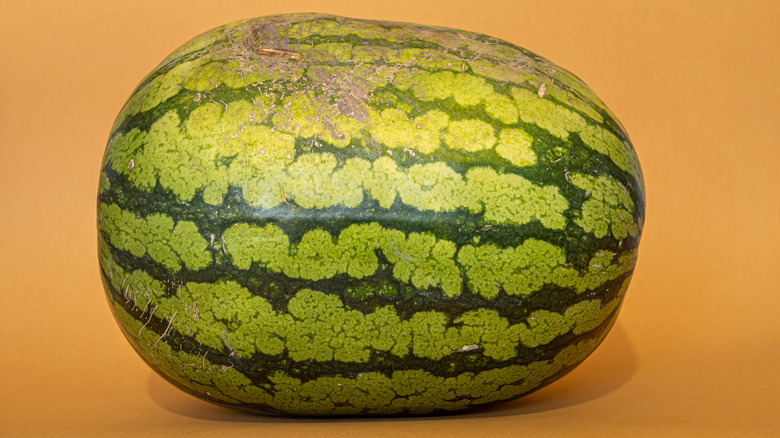
For folks who take the responsibility of choosing the best watermelon seriously, chances are you're familiar with the recommendation to look for a "webbing" pattern on the fruit's surface. But what exactly causes these patterns to emerge, and why is it one of many factors you should know when choosing the tastiest watermelon? Webbing refers to coarse, sandy-brown patches found on the outer rind of a watermelon. They tend to be mistaken as a sign of rot or damage, and are passed on for a watermelon with a glossy, smooth surface. However, underlying the rough, web-like pattern is a fascinating botany that yields a succulent harvest that surpasses "unblemished" melons in the taste department.
Also known as sugar spots, a noticeable webbing pattern possibly indicates a sweeter watermelon. This is likely because webbing is perceived as a telltale sign of pollination by their pollinators, which include native bee species and honey bees. Watermelon flower pollination is crucial for successful fertilization, and the more pollination that occurs, the better the quality of the resulting fruit. When bees pollinate watermelon flowers, they scar the membranes that will eventually form the fruit. As more bees pollinate the flowers, more scarring occurs, resulting in an increased webbing pattern.
Watermelons are a prime example of how, when you learn to appreciate physical "imperfections," there's a world of beauty waiting to be discovered, sometimes in the form of a juicy, sweet fruit. However, relying on webbing alone isn't a foolproof method for choosing the sweetest watermelon, as other external factors like climate and stress may also cause webbing. That said, keeping a lookout for webbing patterns is still a useful guide for your next grocery store or farmers market trip.
Train your senses to choose the best watermelon
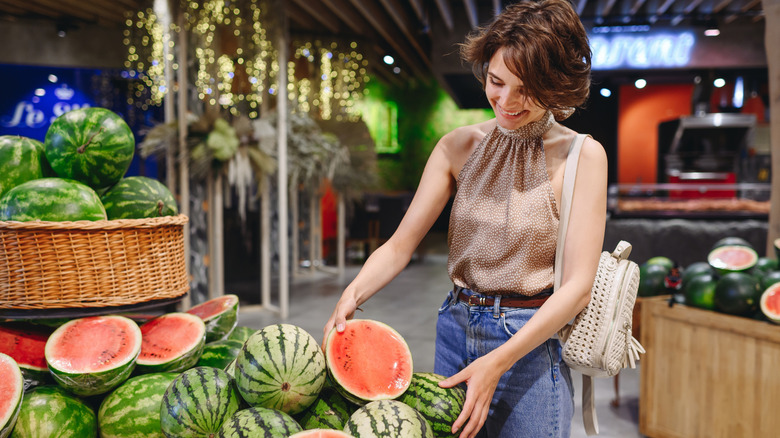
To become an expert at choosing watermelons, there are a few extra tips that help tip the odds in your favor. After all, one can't deny the teeny influence that luck plays when you take your pick from a sea of lookalike watermelons. However, that is not to say that certain visual and auditory cues aren't valuable when selecting watermelon, as these traits indicate important information about the growing conditions before harvesting that impact how sweet and juicy the fruit is.
Once you've spotted a promising watermelon with good webbing, take a closer look at what's called the field spot. It's a pale patch on the outer rind where the watermelon was in contact with the ground. If the fruit ripens in the sun for a longer period of time, this spot will have a darker, more golden hue, which translates to a sweeter flavor. Another hack for choosing a watermelon is the two-finger test. If the dark green striation is at least the thickness of your index and middle finger, that's a sign of perfectly ripened watermelon.
Look out for auditory cues as well. Give the fruit a firm knock and listen for a deep, hollow sound, which indicates a juicy interior. Anything less than could suggest under- or overripe flesh. Shape and weight also matter. Choose a melon that is symmetrical and heavy for its size, which is usually a sign of high water content, and avoid those with irregular bumps. If you happen to end up with a watermelon that lacks sweetness, you can try to sweeten it with a sprinkle of salt. With this handful of hacks, along with the positive vibes from the universe, let your watermelon shopping adventures begin!