

How To Ferment Kimchi Faster Without Compromising Taste Or Texture
We may receive a commission on purchases made from links.
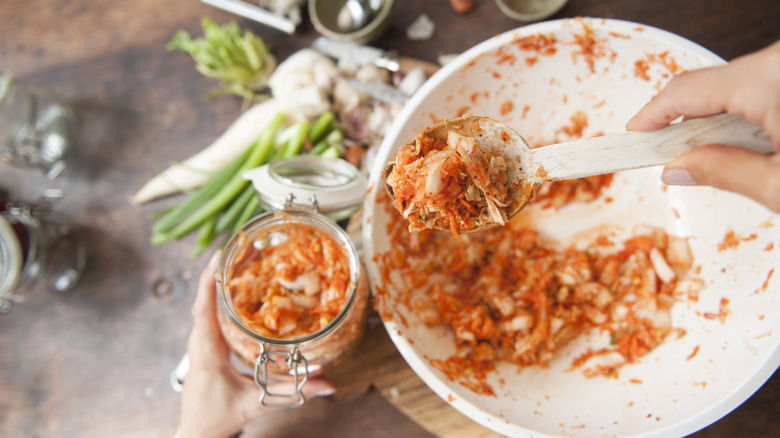
Making kimchi at home can be a relatively straightforward process, but it still requires attentiveness when preparing your ingredients. You'll want to make sure you take care not to choose vegetables that will ruin your batch, in order to achieve the best possible result. After being prepped, kimchi will start its natural fermentation process from 24 to 48 hours at room temperature, but are there ways to speed this up without risking a ruined recipe?
Korean cooking expert Sarah Ahn spoke exclusively with Chowhound to enlighten us about the fermentation process, which is discussed in her book, "Umma: A Korean Mom's Kitchen Wisdom and 100 Family Recipes." Though kimchi can be made year-round, Ahn says, "It's trickier to speed up fermentation in the summer without compromising taste." Noting that heat plays a role in the pace of fermentation, she continues, "forcing it to go even faster can make the kimchi taste sour and unbalanced." However, if you're looking to speed things up in the chilly season, Ahn expresses that during the winter months, "you can let it sit out at room temperature."
If you're worried about fermentation taking too long, you can increase the speed of this process by carefully removing any residual salt on the cabbage leaves before mixing and placing it in an expert-advised airtight container. The more salt, the longer the fermentation will take. If you're struggling on the other side of this, where the environment is seemingly too cold, you can try adding a small amount of sugar or rice flour, which can help move the fermentation process along.
Speeding up kimchi fermentation is a careful process
Sarah Ahn emphasizes that despite the fact that the fermentation process can be sped up, it isn't always advisable. Though there are recipes to make emergency quick kimchi that you can immediately eat, the flavors will not become fully enmeshed until they ferment for longer. When discussing the downsides of this process, she says, "Kimchi always tastes best when you let it ferment at its natural pace." She notes that rushing "can lead to overly sharp, unbalanced flavors and lack of depth."
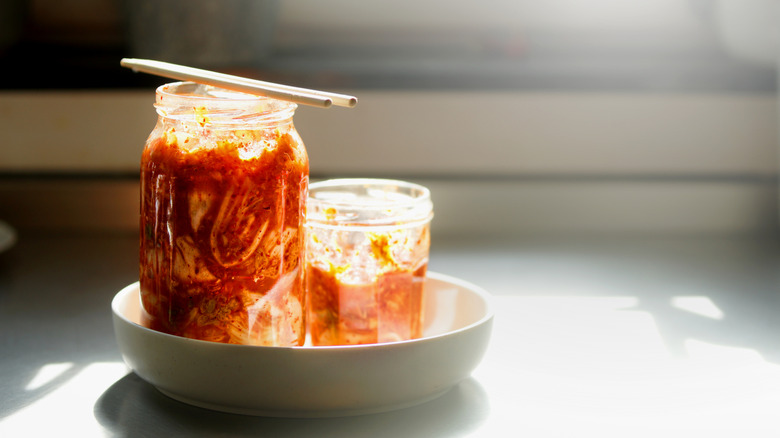
Speeding up the process by raising the room temperature can produce undesired bacteria in your final product. Unwanted mold growth can result from common mistakes during the kimchi-making process. Simultaneously, it runs the risk of harming the good bacteria needed to develop kimchi's quintessential sour, tangy taste. When preparing your batch, Ahn's book states, "The jar should contain wilted-looking vegetables with muted, darkened color, surrounded by a thin juice." One of the telltale signs of properly fermented kimchi is its flavor — "when you taste it, there will be a pronounced tangy sourness that comes from the longer fermentation," Ahn adds.
If something seems off, it's best to ditch the batch and try again, as it's not worth the risk of accidentally consuming something that will make you sick. Though it's also important to note that sometimes, unintended white spots on your kimchi may just be yeast as a result of the contents becoming exposed to air. If you aren't sure, mold usually appears as slightly raised green, black, or pink patches — so just make sure you're aware of the difference.