

Jimmy Buffett's Signature Margaritas Feature An Unexpected Ingredient
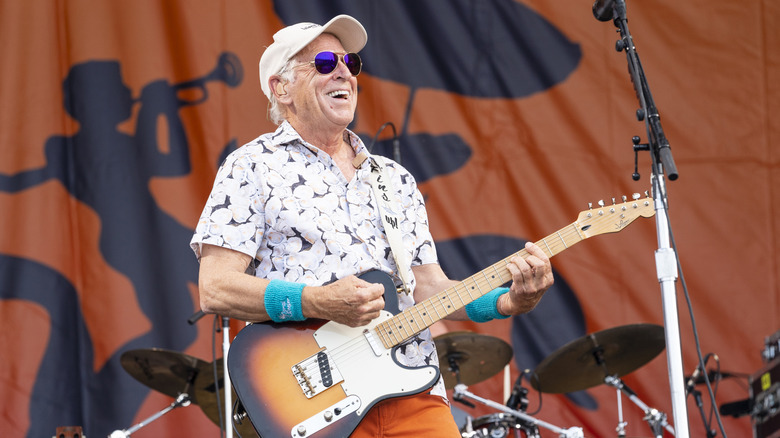
For many, the name Jimmy Buffett conjures images of white beaches and palm trees, smooth rhythms and island living. But the artist's decades-long legacy doesn't just encompass hundreds of popular, toes-in-the-sand tunes. Just after the dawn of his mainstream popularity, Buffett's career took a culinary turn. If you started humming a ditty about paradisiacal cheeseburgers, though, you're on the wrong track. The story actually began when the preeminent "Margaritaville" was recorded in 1977, catapulting the musician to fame and marking his gastronomic genesis.
It wasn't long before the song was poured into a real-life cocktail shaker — although not initially at the singer's behest. A Mexican restaurant chain tried (unsuccessfully) to trademark a Margaritaville drink special in 1983, but after the lawsuit was settled, Buffett realized the potential of the brand and opened his own Margaritaville store in Key West, accompanied by a restaurant a couple of years later. These days, there are more than 30 Margaritaville restaurants in operation, and the singer is irrevocably tied to the classic cocktail.
Even though the margarita wasn't his preferred drink, Buffett had a signature recipe with an unusual addition (and a strange subtraction). Like most, his margarita requires tequila, lime juice, triple sec, sugar, and salt — but rather than the typical ice for shaking or serving, the mixture calls for a few tablespoons of water and a chilled shaker. This straight-up margarita preparation bypasses ice's inevitable dilution to preserve and enhance the drink's flavors.
Water isn't just dilution — it's a flavor solution
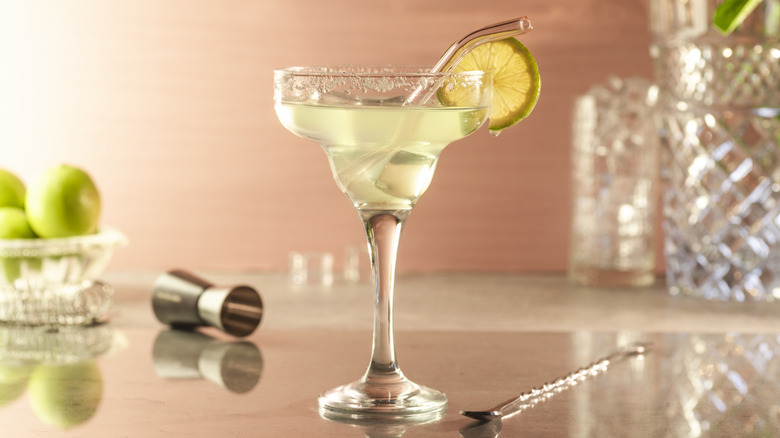
Straight-up is certainly not the most common way to serve a margarita. In fact, most Margaritaville restaurants specify that the franchise's Perfect Margarita comes on the rocks. But Buffett's method has some scientific backing (as well as an endorsement from celebrity chef Bobby Flay, who uses the same ingenious technique in his margaritas).
Spirits are made up of alcohol and water molecules, plus sensory compounds. Those aroma and flavor compounds adhere tightly to the alcohol molecules, so when a spirit has a high ABV, the tastes and smells get trapped, and the palate primarily encounters the alcohol's burn. When a little water is added into that chemical equation, the sensory compounds begin to release their hold on the alcohol molecules, opening up and allowing the drinker to experience an enhanced flavor. It's the principle behind putting water in whiskey and even in wine.
Margaritas served over ice, though, quickly skip from aroma enhancement to watered-down booze as the ice melts in the glass. You can certainly put ice in the shaker and strain to straight-up for a dilution effect similar to adding water, but measuring out water as an intentional ingredient allows you more control and helps ensure the resulting cocktail is balanced. A chilled shaker or glass will guarantee the drink keeps cool and that you stay refreshed as you waste away in Margaritaville.