

How Crab Rangoon Became A Chinese Restaurant Staple
We may receive a commission on purchases made from links.
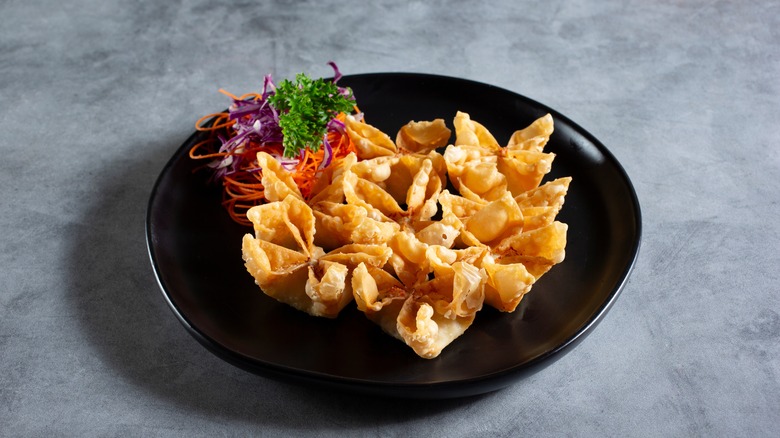
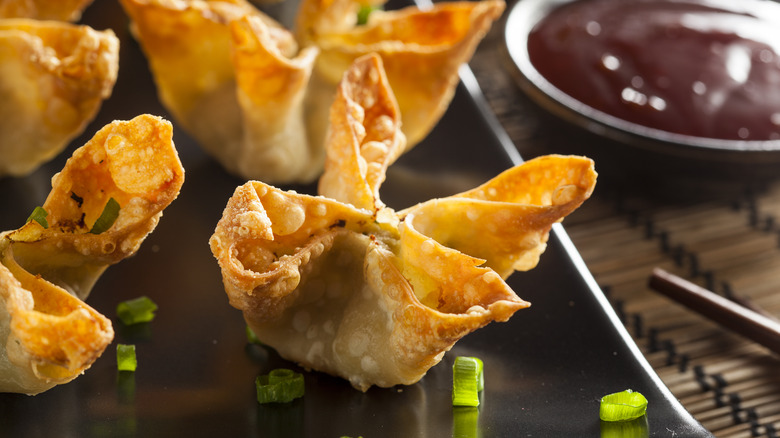
There is perhaps no American Chinese menu item more beloved and less understood than the crab rangoon. Consisting of a fried shell filled with cream cheese, artificial (or real) crab, and is often served with sweet and sour sauce for dipping, the dish is equal parts delicious and confounding. In recent years, crab rangoons have become the internet's snack of choice, both because of its crave-worthy blend of sweet and savory tastes and because, well, when you really think about it, they make absolutely no sense within the general landscape of Chinese cuisine.
After all, unlike many other Chinese American food staples, there is seemingly no Chinese predecessor to the rangoon. Not just this, but its primary component, cream cheese, originated in the United States and not China. Not just this, but rangoon, half of the dish's title, is named for a city now known as Yangon in Myanmar, not China. So how, then, did this mix up of various influences, naming schemes, and ingredients, come to be an American Chinese food staple? Like so many American Chinese menu items, such as the complicated roots of the fortune cookie, the exact story is still unclear. However, the most common explanation points to the crab rangoon originating, not in a Chinese restaurant, but in a tiki bar named Trader Vic's.
The contested origins of the crab rangoon
Trader Vic's, a world-famous tiki bar chain originating in San Francisco, has for decades staked its claim as the point of origin for crab rangoons. And though this claim has been challenged, no other clear inventor has been named. According to Eve Bergeron, granddaughter of Victor Bergeron, the founder of Trader Vic's, credits the food's invention to her grandfather's habit of improving in the kitchen. And, hey, he has a winning track record given that Trader Vic's is also the originator of the beloved mai tai cocktail. You can still try a mai tai Trader Vic's way in Atlanta Georgia, where one of the chain's last two locations stands. However, she also gave due to Joe Young, a Chinese-American employee of the bar who helped give Chinese influence to the menu. Regardless of whether Trader Vic's actually invented the crab rangoon, it still a piece of restaurant history. It did inspire the now iconic, tiki-themed Trader Joe's grocery chain.
No exact invention date is known, but regardless of its origins, it came to be an American Chinese food staple by the end of the 20th century, partly due to what Jennifer 8. Lee, author of "Fortune Cookie Chronicles," calls an "open source" format for curating Chinese food menus. Essentially, restaurants were apt to take items from other restaurants that were a known hit, and put their own spin on them. Over the 20th century, this created a near-universal menu that now feels ubiquitous among Chinese restaurants in America. And while this can help make each experience consistent, it also blurs the origins for many dishes.
Why the rangoon endures
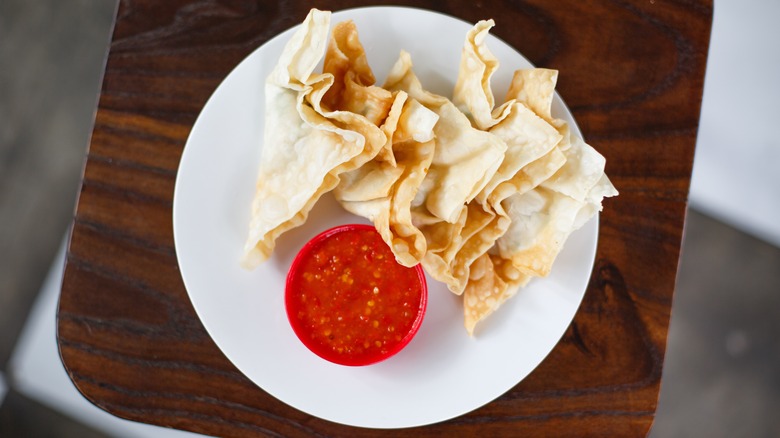
Regardless of its origins, crab rangoons are the perfect mascot of the very specific genre of American Chinese food, blending uniquely American ingredients and flavor profiles with American Chinese influence. Take, for example, the cream cheese filling. Cream cheese isn't Chinese. In fact, it isn't particularly prominent in any other Chinese American dish. Invented in New York in the 19th century, cream cheese quickly became a staple in many Jewish households. But it wasn't until the 1940s and 1950s that cream cheese went mainstream, and it did so in a big way, making its way into endless American cookbooks of the era. You could find cream cheese in practically everything, from desserts to dips and, or course, appetizers such as those delicious crab rangoons.
Now, the imitation crab is another story. First invented in the 1970s, this ingredient is a relatively late-comer to the dish. However, it is a common find on American Chinese food menus, and points to the crab rangoon's full immersion into American dining culture. This, along with its wonton wrapper and pairing of sweet and sour sauce (an American Chinese staple that has roots in Cantonese cuisine), make it the perfect fusion of many disparate elements, coming together to form a dish that transcends origin. Simply put: like Taylor Swift, the crab rangoon needs no explanation, it stands on reputation alone.