

Duff Goldman's Secret To Fluffier Egg Whites Couldn't Be Easier

Egg whites can be tricky to work with in any recipe — too thick, too runny, difficult to mix with other ingredients, etc. So, you're wise to take every egg white advantage you can. It turns out the age of your eggs does make a difference when whipping them. You'll actually get more volume from thinner (i.e., older, but still fresh) whites. While it may not make much of a difference in an egg white scramble, you generally want your egg whites at room temperature when baking.
To get perfectly fluffy egg whites every time, Food Network star Duff Goldman tells People, "If you know you'll be baking, place your eggs on the counter the night before. At room temperature they won't seize up when mixed with the butter, and egg whites whip up fluffier."
Goldman first came to fame on Food Network's "Ace of Cakes," and has since gone on to be a best-selling author and regular judge on the network, so we can probably trust him on the subject. However, maybe take it with a grain of salt. Goldman's advice goes against the USDA's recommendation for how long you can safely leave eggs out at room temperature. The USDA says just two hours max, unrefrigerated. So, if you don't want to leave your eggs out overnight, what are some other ways to bring them to room temp more quickly, and why do it at all?
Why you want eggs whites at room temperature
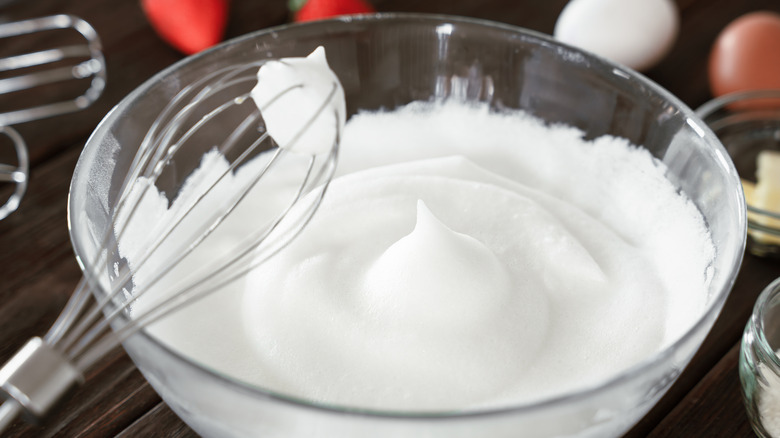
Room-temperature eggs get fluffier faster and whip into stiff peaks more easily. Not using room-temperature whites is another one of the common mistakes everyone makes when baking meringue, for example. Whipped warm whites will also remain more stable for hard-to-bake dishes, like a soufflé. When mixed with other ingredients, like eggs and butter (that should also generally be at room temperature), they will mix and emulsify much more easily. Your cake batter will turn out smooth and shiny, rather than dull and clumpy.
To get eggs to room temperature (between 68 and 74 degrees Fahrenheit), you can still leave them on the counter, and it doesn't have to be overnight. Depending on the temperature of your fridge and the actual "room temperature" of your kitchen, it could take as little as 30 minutes. You could also place them in a bowl of warm water for about 5 to 10 minutes, until the shell feels warm to the touch — just be sure the water isn't too warm because you don't want them cooking inside the shell. However, the quickest and easiest way to delicately warm your whites is to separate the yolk from the white right out of the fridge. Once separated, place the bowl of whites over a bowl of warm water (stainless steel is best) and they'll warm much more quickly. The added benefit of this method is that it's much easier to separate the yolk from the white when the eggs are cold.
So, whether you choose to trust world-class pastry chef Duff Goldman or the USDA, there are plenty of ways to get your egg whites to room temperature in time for any task at hand.