

The Historical Cooking Technique Used To Make Salt And Vinegar Chips
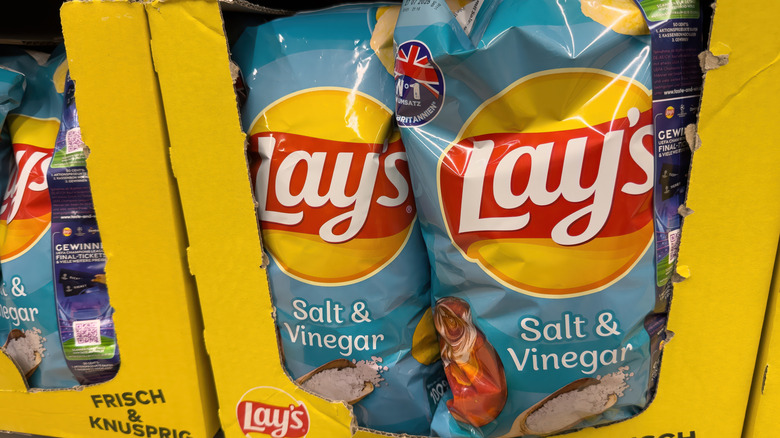
Poké Bowl, lasagna, and haggis are all national dishes. But they're also chip flavors, made from acids, esters, and salts that replicate the dish in question. Despite all the wacky flavors, salt and vinegar chips remain a fan favorite, proving that classic is best. Between 70% to 80% of British brand Tyrrells' sales come from just four flavors, including salt and vinegar. This isn't surprising for a nation obsessed with fish and chips, but the history of pairing salt and vinegar in powdered form goes way beyond the birth of the chip.
Tayto, based in Ireland, is credited with inventing the first salt and vinegar crisps in the '50s, and they arrived in U.S. grocery stores in the '70s. Makers of the potato snack spray the flavorless powder maltodextrin with vinegar, or by use sodium diacetate, with a 1:1 ratio of sodium acetate and acetic acid to add the distinctive salt and vinegar kick.
A home recipe for dry vinegar appeared in the 1615 book, "Containing the Inward and Outward Virtues Which Ought to be in a Complete Woman." It reads (via Serious Eats): "To make dry vinegar which you may carry in your pocket, you shall take blades of green corn, either wheat or rye, and beat it in a mortar with the strongest vinegar you can get till it come to a paste; then roll it into little balls, and dry it in the sun till it be very hard; when you have an occasion to use it, cut a little piece thereof and dissolve it in wine, and it will make a strong vinegar." So why not take a leaf (or blade of corn) out of the cookbook, and try your hand at making the classic crisp from scratch?
Why does salt and vinegar taste so good?
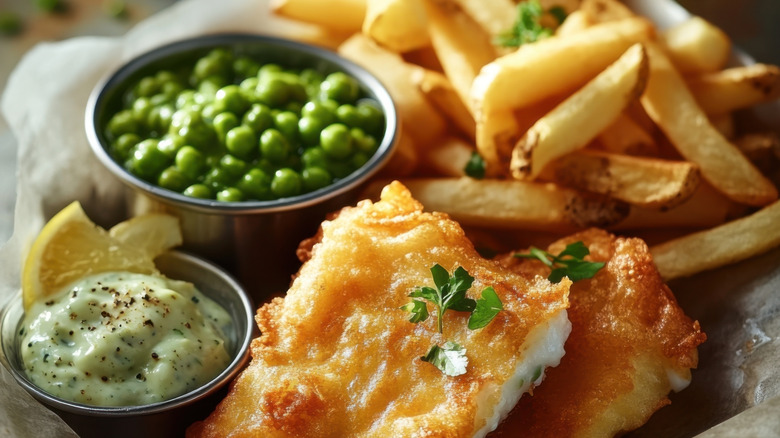
When chips were taking off as a popular snack, factories jumped on cheese and onion (which are still a British staple), and then salt and vinegar, as a dream flavor combo. Clearly, they were onto a winner, but what was the thinking behind the decision? According to food historian Nadia Berenstein, experts considered crisps as potatoes, and sought to mimic traditional spud-like tastes in with the snack (via The Guardian). But why does salt and vinegar taste so good in the first place, whether it's distilled into a crunchy bag, or doused over fries with a healthy dose of ketchup and mayonnaise — a staple condiment at 'chippies' across the U.K.
Well, food scientist Arielle Johnson, author of Flavorama, has all the answers. She tells Vinegar Professor that vinegar is an "interesting acid as it has an aroma (vinegary), as well as a taste (sour)," and "trigeminal, touch-related flavor (the pungency/burn)." But what really makes it stand out with salt is that the two really need each other. The pair intensifies each other at low concentrations, she explains, and reduces each other at higher ones.
So, salt can make sour chips more palatable, and vice versa. This is why salt and vinegar chips make delicious additions to a fish sandwich, but they're best enjoyed straight from the packet. And history would agree, with foodies from as far back as the 15th century catching onto the marvelous discovery that is salt and vinegar.