

How To Choose The Right Whisk Depending On Your Recipe
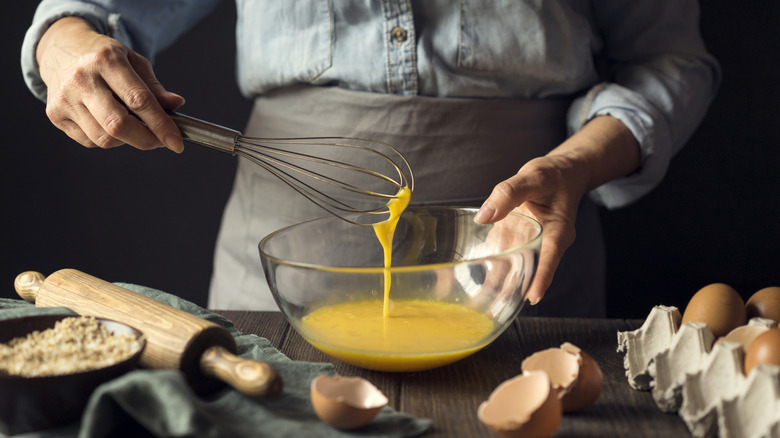
The humble whisk might not get much love compared to other cookware staples, such as knives or pans, but it's a ubiquitous presence in the kitchen nonetheless. Knowing the right model to use can really make the difference when it comes to how efficiently (and effectively) you can make a particular dish. A balloon whisk doesn't do you much good when it comes to mixing dough, for example, and a dough whisk isn't much help when it comes to making a meringue.
Picking the right whisk saves you time, effort, and, potentially, money. The wrong whisk, however, can leave you with underworked sauces prone to separating, egg whites that sink your soufflé, or clumpy, floury batters. Specialised equipment is nothing new in a kitchen; people wouldn't think twice about using a particular kind of knife for a certain job, after all. You might not even be aware of how many different types of whisks there are, but fear not. Here's a comprehensive rundown of five of the most popular types and how to use them. You'll be whisking like a pro in no time!
The balloon whisk is best for volume and airiness
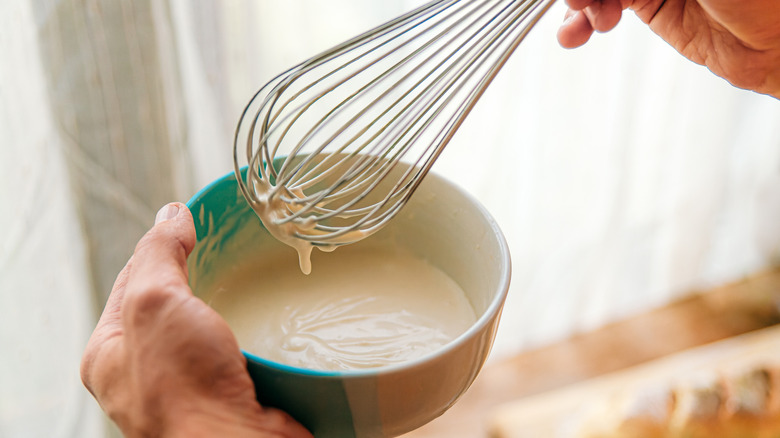
When you think of a whisk, chances are you're picturing one of these. They're large, with a bulbous shape and a crisscross of wire (or plastic, depending on what your whisk is made of) with a big open space in the center. All that empty space also means that it moves effortlessly through liquid. The balloon whisk is built to make contact with the maximum possible surface area, so it's great when you want to get lots of air into whatever you're whisking. Because it's so good at taking on large quantities of liquids at once, it's the best choice for batters, especially lighter ones that you might use for crêpes or tempura. It's also a go-to when whipping cream or chickpea water (aka aquafaba, which is great for foamy cocktails), or for achieving perfectly fluffy eggs.
Avoid using one for thicker mixtures such as cookie dough, which can get stuck in the center of the whisk (and are surprisingly tricky to get out). To get the best out of your balloon whisk, use it in a big bowl (preferably a purpose-built mixing bowl) with a wide, smooth base. These offer you the best range of motion so you can really focus on getting air into your mixture without too much effort.
Choose the French whisk for versatility and control
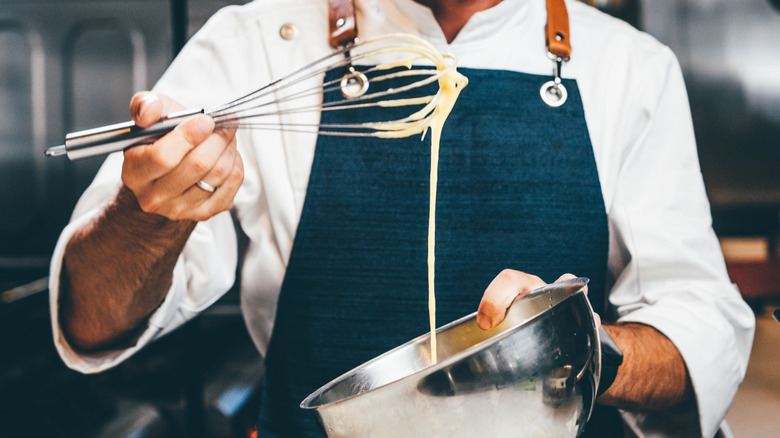
The French whisk is often mistaken for a balloon whisk since their designs are broadly similar. While less commonly seen in home kitchens, the French whisk is a mainstay in restaurant kitchens. It's beloved by chefs for the precision it affords its user, as well as its useful versatility. While it resembles a balloon whisk from afar, it's longer, more compact, and has a little more rigidity. You sometimes see them with a slight taper, which is perfect for whisking smaller quantities. As such, it's great for making vinaigrettes, salad dressings, and marinades.
It's also great for mixing warm sauces, whether you're blending a homemade béarnaise (a perfect sauce pairing for steak) or mounting some butter into a classic French beurre rouge. Sauces that require gentle, careful work are especially grateful for the presence of a French style whisk (think custards, such as crème pâtissière or crème Anglaise, and rich emulsifications, such as hollandaise). The greater control the smaller, tighter whisk affords means that you've got a better chance of really nailing those dishes where texture is crucial. Use them in conjunction with small-to-medium-sized bowls, especially ones with high rims, to stop any spillage. Though you probably have a balloon whisk in your kitchen right now, if you only buy one whisk, make it this one. It's the Swiss Army knife of the whisking world.
Use a flat whisk for pan sauces, gravies, and scraping roasting trays
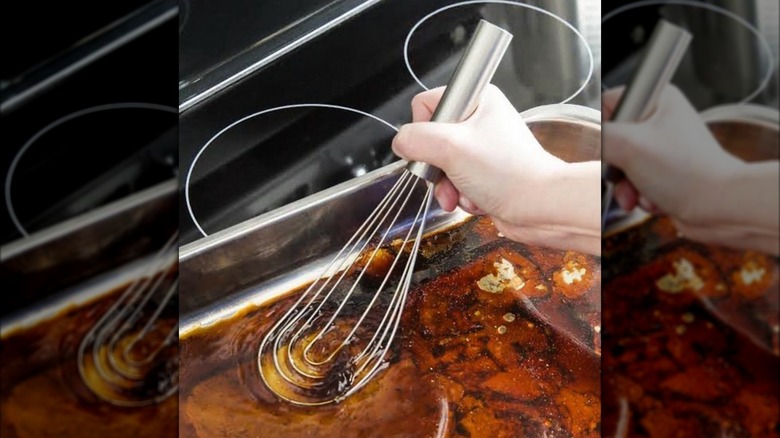
The flat whisk doesn't look unlike a dough whisk, but it is a totally distinct and specialized tool. Not one that's essential to own by any stretch, but if you cook a lot and want to start making pan sauces, it's a useful thing to have in your culinary arsenal. The flat whisk is (somewhat unsurprisingly) flat, or ever so slightly curved, with wires splaying outwards. This makes it ideal for use in shallow pans, or for scraping up the good bits on the bottom of a roasting tray when making a delicious homemade gravy. It's pretty much a hybrid between a whisk and a rake, so don't be afraid to use it to scrape away at pans if there's fond to be used.
This whisk is also great when it comes to making roux-based sauces (think béchamel or sauce éspagnole) as well as the aforementioned gravy. If you need a whisk that makes great contact with the bottom of a pan, and gives you consistent results while maintaining an equally consistent temperature, this is the tool for you. Its unique shape means you're able to cover the entire cooking surface, avoiding any burning in particular spots, as well as reducing the risk of your sauce separating. It's also ideal for silky smooth sauces with a rich, glossy texture since it stirs and emulsifies without introducing much air, helping you retain that spoon-coaxingly rich consistency.
Use a ball whisk for clump-free dry ingredients
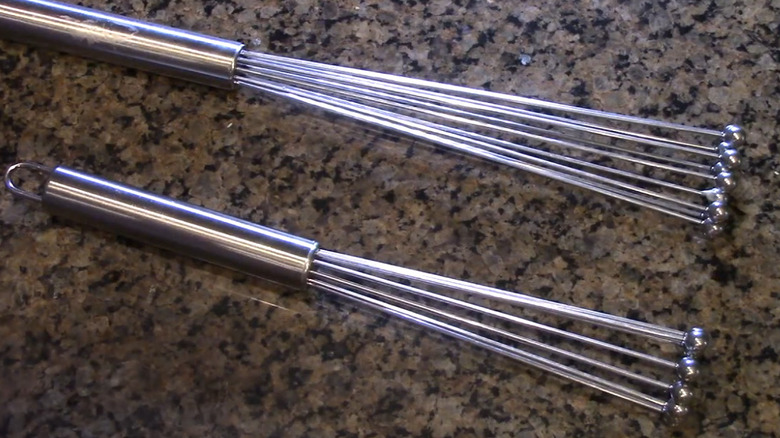
Sometimes called an egg whisk, the ball whisk is what it says on the tin. Instead of a mesh of wires all tangled together, it consists of several straight wire rods that are tipped with a small metal (or silicone) ball. These balls move independently rather than all as one unit, making this whisk ideal for mixing dry ingredients. The ball whisk is great, then, for making sure there aren't any clumps in your flour before you bake with it (if you don't have a sieve on hand, though if you're buying specialized whisks, you've probably got one). It's also good for blending dried herbs and spices, as well as incorporating yeast, baking power, or baking soda into your dry ingredient mix if you're making cakes, breads, or pancake batter.
Each of the balls works like its own tiny mixer, effectively breaking up clumps and dragging through ingredients with little resistance. It also gets into those little nooks and crannies at the edge of a bowl, sauce pan, or container. This makes it ideal for emulsifying small quantities of sauce, such as salad dressings, as well as ensuring scrambled eggs are properly mixed. It's also ideal when you're incorporating wet ingredients into dry ones (or vice versa), effectively distributing ingredients with relative ease and efficiency.
Use a spring whisk for the smallest of spaces
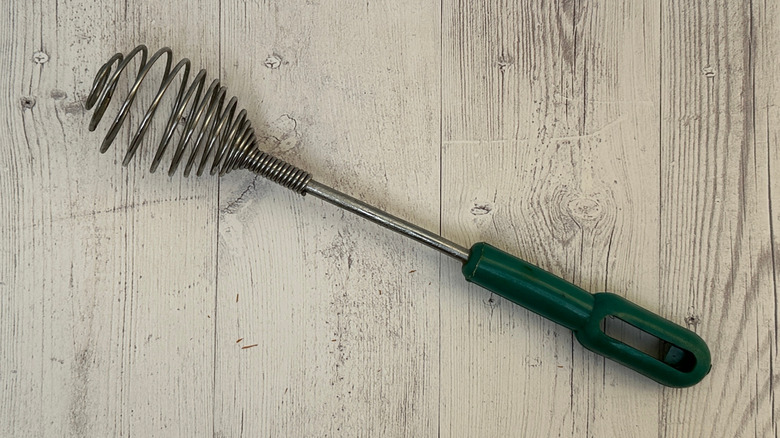
While every other whisk on this list requires a bit of muscle to get the best out of it (or at least a bit of effort as far as your wrists are concerned), the spring whisk is a little different. At the end of the handle sits a coiled loop of wire (the spring in question), which you use in an up-and-down motion rather than a more traditional side-to-side or circular one. The powerful action of the spring is great for emulsifying sauces, as well as blending melted ingredients into custards, such as chocolate and fats, without breaking your sauce. It's handy for frothing warm milk, too, if you fancy an at-home cappuccino without buying your own coffee machine.
It's versatile and, much like the ball whisk, works well when you've only got a small bowl or container to use for whisking. This makes it ideal for working ingredients while simultaneously heating them. It's effective at tasks such as emulsion because of the steady, powerful mixing motion it uses. The coil of wire is essentially a spring-powered stirrer, which keeps the liquid effectively moving without causing too much agitation (introducing air and altering the texture). While not strong or big enough for use with large batches, taking on lots of liquid at once, or mixing heavy-duty ingredients such as dough, it's perfect for use with small saucepans and when heating using a double boiler.